
Yoga Nidra Explained: Benefits of Yogic Sleep for Deep Relaxation

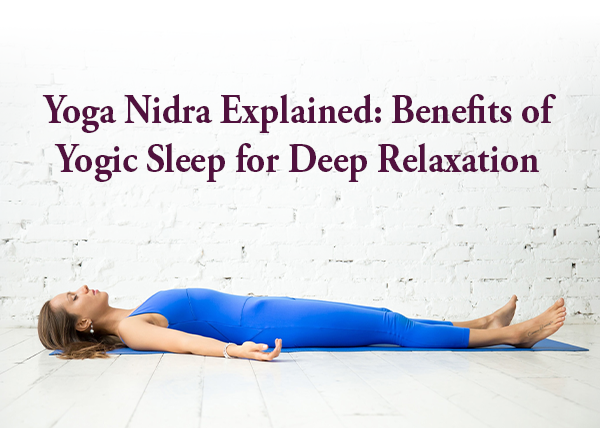
Yoga Nidra is often translated as “yogic sleep,” but that does not simply mean taking a nap on your yoga mat. It is a structured, guided relaxation practice usually done lying down where attention is systematically brought through the body, breath and awareness while you remain as conscious as comfortably possible. The goal is not to fall asleep but to enter a state of deep, intentional rest with some degree of awareness maintained throughout.
If you have been curious about what Yoga Nidra actually involves, whether it has any real benefits, how it differs from ordinary sleep or seated meditation, and how to start as a complete beginner, this article covers all of that clearly.
Quick Takeaways
- Yoga Nidra is commonly translated as “yogic sleep” but is practised as guided deep relaxation rather than ordinary sleep.
- A typical session involves lying comfortably while a teacher or recording guides attention through the body, breath and awareness.
- Research around Yoga Nidra and sleep quality is promising but still developing strong, conclusive evidence is limited.
- Yoga Nidra should complement healthy sleep habits, not replace them.
- Beginners can start with short guided sessions of 10–20 minutes and build from there.
What Is Yoga Nidra?
Yoga Nidra is a guided relaxation and awareness practice traditionally practised lying down. The word nidra means sleep in Sanskrit, which is why it is commonly called yogic sleep. A teacher or audio recording leads the practitioner through systematic stages of attention body awareness, breath observation and sensory awareness while the aim is to remain gently present rather than fully asleep.
Unlike a nap, Yoga Nidra is intentional and structured. Unlike an active yoga sequence, it requires no physical effort. It sits somewhere between wakefulness and sleep as a dedicated practice of deep guided rest.
The experience can vary between practitioners and even between sessions. Some people remain clearly aware throughout. Others drift in and out. Both can be part of the practice, though remaining gently present is generally the stated intention.
Why Is Yoga Nidra Called “Yogic Sleep”?
The name comes from the traditional yogic understanding that there are different states of consciousness waking, dreaming, deep sleep and subtler states of awareness. Yoga Nidra, in classical practice, was associated with navigating these states consciously, particularly moving into the borderland between wakefulness and deep rest.
That is where the name “yogic sleep” comes from not because the practice is the same as going to bed, but because it intentionally explores the territory of deep rest while keeping some thread of awareness alive.
This distinction matters practically:
Yoga Nidra uses the language of sleep and deep rest, but practising it is not equivalent to the biological sleep your body needs each night. It is a wellness and relaxation practice, not a physiological substitute for restorative sleep.
Yoga Nidra vs Regular Sleep at a Glance
| Yoga Nidra | Regular Sleep |
| Usually intentionally guided | Occurs naturally |
| Awareness may be maintained | Conscious awareness usually decreases |
| Can be practised in a short session | Occurs in repeated multi-hour cycles |
| Used as a relaxation and meditative practice | Essential biological recovery process |
| Does not replace required nightly sleep | Required for normal health and functioning |
How Does Yoga Nidra Work in Practice?
A typical guided Yoga Nidra session follows a loose structure, though the exact format can vary depending on the teacher, lineage or style. Here is what a session commonly includes:
Settling Into a Comfortable Position
You begin by lying down usually in Savasana, flat on your back and taking a few moments to settle. Props such as a blanket under your knees, a cushion under your head, a bolster along your spine or an eye covering can all make the position more comfortable. There is no need to hold yourself in a particular shape. Comfort is the priority.
Setting an Intention (Sankalpa)
Many traditional approaches to Yoga Nidra include a Sankalpa a short, positive personal intention or resolve that you bring to mind at the beginning and end of the practice. This might be a quality you are working to cultivate or a meaningful statement about your direction in life. It is a traditional element and not about instant manifestation. Think of it simply as an intentional anchor for the practice.
Body Awareness or Rotation of Consciousness
A central feature of many Yoga Nidra practices is being guided to bring attention to different parts of the body in sequence a hand, a thumb, a finger, the wrist, the forearm, and so on moving through the entire body. This is sometimes called a rotation of consciousness. It sounds methodical, and it is the systematic nature of it is what helps settle the mind away from scattered thinking and into the present moment.
Breath Awareness
At some point the guidance usually invites you to notice your breath as it naturally moves. You are not asked to control it or hold it in any way simply to observe the natural rhythm of breathing in and breathing out. This gentle inward attention supports the overall experience of settling.
Awareness of Sensations, Images or Opposites
Some traditions introduce pairs of opposites warmth and cold, heaviness and lightness or invite brief awareness of imagery or sensations. This part of the practice varies widely between different schools and teachers. The intention is generally to keep awareness active rather than to drift into distracted thought.
Returning Gradually to Waking Awareness
Sessions close by gradually returning attention outward to the breath, to the sensation of the body against the floor, to sounds in the room. You are usually invited to move your fingers and toes, stretch gently and take your time sitting up. This gradual re-emergence is considered part of the practice rather than simply a formality.
Yoga Nidra Benefits: What Does the Research Suggest?
Yoga Nidra is primarily a relaxation and mindfulness practice with roots in classical yoga. Many people report that regular sessions help them feel calmer, more rested and better able to manage the demands of daily life. Here is what research has found so far and where the evidence is still catching up.
Deep Relaxation and Perceived Stress
The most consistently reported benefit of Yoga Nidra practice is a sense of deep physical and mental relaxation. By slowing down, reducing external stimulation, guiding attention through the body and allowing intentional stillness, the practice gives the mind a genuine pause. For people whose days are dense with mental demands, screens and social input, that structured pause can feel meaningful.
Several studies have explored Yoga Nidra in relation to stress and mood. A broader integrative review of Yoga Nidra research covering 29 studies found positive outcomes across areas including stress, mood and general wellbeing. However, the review also noted substantial differences in how studies were conducted including variation in session lengths, populations and protocols which makes broad conclusions difficult. The results are encouraging, but the picture is not yet complete.
Yoga Nidra and Sleep Quality
One of the most common reasons people search for Yoga Nidra is to support better sleep. A 2026 systematic review and meta-analysis of Yoga Nidra and sleep examining its effect on sleep disturbances and insomnia found promising but limited evidence. Only five unique studies contributed across the analyses. Randomized trial results for major sleep-quality outcomes were not statistically significant, and the overall certainty of the evidence was rated as very low. The studies were also geographically concentrated, which limits how broadly findings can be applied.
What this means in practical terms: Yoga Nidra may be a genuinely supportive relaxation practice for some people, and incorporating it as part of a calmer evening routine could be a reasonable choice. But current research does not support presenting it as a proven treatment for insomnia. Anyone dealing with persistent sleep difficulties should work with an appropriate healthcare professional.
Yoga Nidra for Mental Rest and Mindfulness
Beyond the specific research, Yoga Nidra shares common ground with other mindfulness and body-awareness practices. Bringing deliberate attention inward, observing physical sensation and breath, and practising non-reactive awareness are all elements associated with mindfulness approaches. Regular engagement with these practices is generally considered supportive of mental rest and present-moment attention though the specific outcomes will vary from person to person.
Does Yoga Nidra Replace Sleep?
No. Yoga Nidra should not be treated as a replacement for normal nightly sleep.
You may have come across claims online that 20 or 30 minutes of Yoga Nidra equals several hours of sleep. These comparisons are widely repeated in wellness spaces, but there is no strong clinical evidence supporting a fixed equivalence like this. Sleep involves essential biological processes hormonal regulation, cellular repair, memory consolidation and immune function that a guided relaxation practice cannot replicate.
Yoga Nidra is valuable as a structured practice that supports rest and awareness. It may help you feel more settled during the day or wind down more easily in the evening. But it works best alongside adequate sleep, not instead of it.
Yoga Nidra vs Meditation: What Is the Difference?
This is a fair question, and the honest answer is that Yoga Nidra is itself often considered a form of meditative practice. The more useful comparison is between Yoga Nidra and other forms of meditation:
| Feature | Yoga Nidra | Seated Meditation |
| Common position | Usually lying or reclining | Often seated upright |
| Guidance | Frequently highly structured | Can be guided or silent |
| Physical effort | Very low | Low |
| Attention | Led through systematic stages | Varies by technique |
| Main experience | Deep guided rest with awareness | Depends on the method |
The key practical difference is that Yoga Nidra tends to be more directive you are guided through a sequence step by step while many meditation practices involve working with attention more independently, whether with a mantra, the breath or open awareness.
Neither is superior. They simply offer different experiences, and some people find that Yoga Nidra is an accessible starting point precisely because the guidance does a lot of the work.
Yoga Nidra vs Savasana: Are They the Same?
They are related but not interchangeable. Savasana is a physical resting posture lying flat on the back, arms slightly away from the body, eyes closed commonly used at the end of a yoga class to allow the body to integrate the practice.
Yoga Nidra is a structured guided awareness practice that is often performed while lying in Savasana but is not limited to the posture itself.
A simple way to think about it: Savasana can be the position; Yoga Nidra is the practice. You can rest in Savasana without doing Yoga Nidra. And Yoga Nidra can technically be done in other supported reclining positions too.
How to Practise Yoga Nidra for Beginners
Starting a Yoga Nidra practice does not require experience, equipment or much time. Here is a straightforward approach for beginners:
1. Choose a Quiet, Comfortable Space
Find somewhere you can lie down without being frequently disturbed. Turn your phone to silent, dim the lights if you can and give yourself permission to be still for a few minutes.
2. Lie Down in a Supported Position
Lie flat on your back or in a position that feels genuinely comfortable. Place a blanket under your knees if your lower back appreciates the support, a cushion under your head if needed and a light blanket over yourself if the room is cool. You are setting yourself up to remain still comfortably for the duration of the practice.
3. Start With a Guided Session
For most beginners, starting with a guided Yoga Nidra recording or a live class is far easier than trying to guide yourself. The structured voice does the navigating, so your only job is to listen and follow along as best you can. Canada Yoga Studio includes guided Yoga Nidra sessions within its weekly program, which can be a practical starting point.
4. Let the Breath Stay Natural
At no point should you feel like you need to breathe in a particular forced or dramatic way. When the practice directs your attention to breathing, simply observe your breath as it naturally is. There is nothing to control.
5. Follow the Guidance Without Trying Too Hard
The goal is not to perform relaxation perfectly. If your attention wanders mid-session and it will simply notice and return to the guidance. That process of noticing and returning is itself part of the practice.
6. Come Out Gradually
When the session ends, resist the urge to jump straight up. Notice the sounds around you, wiggle your fingers and toes, stretch your arms above your head and take a few breaths before gently rolling to one side and sitting up slowly.
How Long Should a Yoga Nidra Session Be?
Sessions can range widely. Many guided recordings available for beginners run between 15 and 30 minutes, which is a very practical length for fitting into a regular routine. Some longer sessions run 45 minutes to an hour.
If you are just starting, a 10–20 minute guided session is a reasonable place to begin. The quality of your attention and the consistency of your practice will matter more than chasing a specific duration. There is no magic number of minutes that produces a fixed result despite what some viral wellness posts claim.
When Is the Best Time to Practise Yoga Nidra?
There is no single “best time” that applies to everyone. Different moments in the day suit different intentions:
After a Busy Workday
Many people find Yoga Nidra useful as a transition between work and the rest of the evening a deliberate signal to the mind and body that the active part of the day is finishing.
In the Evening
Incorporating a short session into a quieter evening routine can be a gentle way to wind down before bed, though it is worth noting that it does not guarantee a particular quality of sleep.
During a Midday Break
If your schedule allows, a short guided session at midday can offer genuine mental rest as a break from sustained concentration.
After Physical Yoga Practice
Yoga Nidra integrates naturally as a closing practice after an active yoga session, allowing the body to settle fully. Canada Yoga Studio’s Multi-Dimensional Yoga program combines mindful movement, breathwork and meditation making it a natural environment to experience this kind of transition from movement into guided rest.
What If You Fall Asleep During Yoga Nidra?
It happens, particularly when someone is tired. There is no need to treat it as a failure or a problem. That said, the practice is designed to be done with some degree of gentle awareness rather than simply as a way to fall unconscious so if you consistently sleep through the entire recording, you might experiment with practising at a different time of day when you are less fatigued, or sitting slightly more upright.
If you do drift off occasionally, you will likely still feel rested when you come around. The difference between deliberately practising Yoga Nidra and simply sleeping through the audio is worth noting, but it does not have to become a source of self-criticism.
Can You Practise Yoga Nidra Every Day?
Many people do incorporate short guided relaxation practices into their daily routines without any issue. Whether you practise daily, several times a week or simply as needed is a personal decision based on your schedule, energy and what feels useful. There is no required minimum frequency, and there is no evidence that occasional practice is without value.
Consistency tends to matter more than intensity. A 15-minute guided session a few times a week that you actually do will be more useful than a 45-minute session you only ever plan to do.
Yoga Nidra, Meditation or Gentle Yoga: Which Practice Fits the Moment?
If you are uncertain which practice to reach for, here is a practical way to think about it:
If you want deep physical stillness and structured guided rest: Yoga Nidra is likely a good fit.
If you want focused seated attention or a silent practice: A seated meditation technique may serve you better.
If you have been sitting at a desk all day and need movement first: Beginning with gentle movement before transitioning into relaxation often feels more natural.
If you want a combined experience of movement, breathwork, meditation and rest: A more complete guided program that integrates all of these elements may be more satisfying than any single practice in isolation.
These approaches work well together. Canada Yoga Studio’s Meditation & Breathwork sessions in Calgary offer structured guidance across meditation and breathwork, which can complement a home Yoga Nidra practice or serve as a starting point for those new to both.
Making Space for Deep Rest With Yoga Nidra
Yoga Nidra is a structured, guided practice of deep relaxation and awareness not a mystical experience, not a replacement for sleep and not a guaranteed cure for any particular condition. What it offers is a reliable method for intentional rest, systematic body awareness and a genuine mental pause that many people find difficult to achieve simply by trying to relax.
Research into its effects on sleep and stress is promising, but honest about its limitations. The evidence is still developing, and stronger studies are needed before firm conclusions can be drawn. What we can say is that many practitioners report genuine value in regular practice, and the approach is low-risk, accessible and compatible with other wellness habits.
Beginners can start with a short guided session and build gradually. Consistency and comfort matter more than session length or technical perfection.
Curious to experience Yoga Nidra with guidance? Explore Canada Yoga Studio’s weekly program to find guided relaxation, meditation and breathwork sessions that fit your routine whether you are entirely new to the practice or looking to deepen a regular habit.
Yoga Nidra Frequently Asked Questions
What is Yoga Nidra in simple words?
Yoga Nidra is a guided deep relaxation practice done lying down. A teacher or recording leads your attention through different parts of the body and breath while you rest as comfortably as possible. The aim is to stay gently present in a state of deep rest somewhere between full wakefulness and sleep. It is accessible to beginners and requires no prior yoga experience.
Is Yoga Nidra the same as sleep?
No. Yoga Nidra is a guided awareness practice, not ordinary sleep. While it may encourage a sense of deep rest, it does not involve the biological sleep cycles that the body needs for recovery and repair. Think of it as intentional guided relaxation rather than a substitute for nightly sleep.
What are the main benefits of Yoga Nidra?
Regular practice is commonly associated with reduced feelings of stress, improved relaxation and a greater sense of mental calm. Some research suggests potential benefits for sleep quality, though the evidence is still developing. An integrative review of Yoga Nidra research covering 29 studies found positive outcomes across wellbeing, mood and stress, though study designs varied considerably.
Is 20 minutes of Yoga Nidra enough?
A 20-minute guided session can be a genuinely useful practice, particularly for beginners. It is long enough to move through a meaningful sequence of body and breath awareness without requiring a large block of time. The quality of your attention and how regularly you practise will tend to matter more than the specific duration.
Can Yoga Nidra replace sleep?
No. Despite claims circulating online, there is no strong clinical evidence that Yoga Nidra can replace the hours of sleep your body needs each night. Sleep involves essential biological processes memory consolidation, tissue repair and hormonal regulation that a relaxation practice does not replicate. Yoga Nidra works best as a complement to healthy sleep, not a replacement for it.
What happens if I fall asleep during Yoga Nidra?
It is quite common, especially when you are genuinely tired. It is not a failure. The practice is designed to be done with some degree of awareness, so if you consistently sleep through sessions, you might try practising at a less fatigued time of day. Occasional drifting off is normal and does not negate the value of the rest.
Is Yoga Nidra the same as meditation?
Yoga Nidra is itself often considered a meditative practice. The key differences compared to other meditation approaches: it is usually done lying down rather than seated, it tends to be more structured and directive, and it is specifically focused on deep guided rest. Many people find it more accessible than silent seated meditation, particularly at the beginning.
What is the best time to practise Yoga Nidra?
There is no single answer. Many people find it useful as a transition between work and evening, as part of a pre-sleep routine or after physical yoga practice. The best time is simply the one you will actually use consistently. Morning, midday and evening all have their own practical advantages depending on your schedule and why you are practising.