
Restorative Yoga vs Yoga Nidra: Benefits & Key Differences

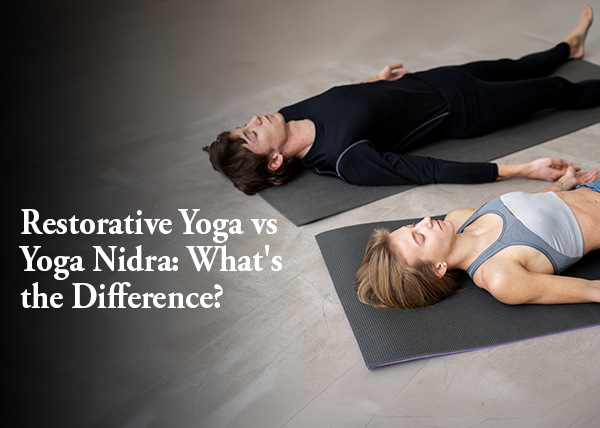
Both practices come up often when someone wants to slow down, step back from a more intense physical routine, or simply give the body and mind some room to settle. But Restorative Yoga vs Yoga Nidra is not a comparison between two versions of the same thing. They are genuinely different in method, structure, and experience.
Restorative Yoga is pose-based. It uses supported physical postures held with minimal muscular effort, usually with props like bolsters, blankets, and blocks. Yoga Nidra is a guided awareness practice where you remain mostly still typically lying down while a teacher or recording guides your attention systematically through the body, breath, and sensations.
Both can fit a relaxation-focused routine. Both are accessible to beginners. But the kind of rest each one offers is distinct, and the right choice depends on what you actually want from the session. If you’re curious about how both might fit into a broader practice, Canada Yoga Studio’s restorative and mindful yoga practices weave together movement, breathwork, meditation and restorative work in a single integrated program.
Restorative Yoga vs Yoga Nidra: The Short Answer
Restorative Yoga uses supported physical postures held comfortably for longer periods, with props playing a central role in making each position sustainable. Yoga Nidra is a guided meditative awareness practice performed in stillness, usually lying down, where the teacher or a recording moves your attention through a structured sequence. Restorative Yoga works primarily through the body. Yoga Nidra works primarily through guided internal awareness. Both can support a slower, more restful practice, but they do this in very different ways.
Restorative Yoga vs Yoga Nidra at a Glance
| Feature | Restorative Yoga | Yoga Nidra |
| Main format | Supported yoga poses | Guided awareness / meditation |
| Movement | Minimal, but includes changing poses | Usually very little movement |
| Common position | Several supported poses | Often lying in Savasana |
| Props | Bolsters, blankets, blocks, straps | Blanket/pillow/bolster optional |
| Guidance | Pose setup + quiet holding | Continuous or structured verbal guidance |
| Primary experience | Supported physical rest | Guided mental and physical relaxation |
| Flexibility needed | Very little | Very little |
| Beginner friendly | Often adaptable | Often accessible |
| Typical purpose | Slow physical practice and rest | Guided awareness and relaxation |
What Is Restorative Yoga?
Restorative Yoga is a style of yoga that uses comfortable, supported postures held with very little muscular effort. The emphasis is not on stretching to a limit or building strength. Instead, each pose is set up in a way that allows the body to be fully supported throughout the hold.
Props are central to how this works. A bolster under the knees, a folded blanket beneath the head, a block under the hips, or the wall supporting the legs these tools change the geometry of a pose so that the practitioner can remain in it without strain. The idea is to find a position where you do not have to work to stay there.
A typical Restorative Yoga session moves through a small number of poses often four to seven each held for several minutes. The transitions between positions are slow and deliberate. Lighting is often dimmed, the pace is unhurried, and longer periods of quiet are common within each hold.
This is not “lazy yoga” or a scaled-down version of something more demanding. It is a distinct practice where physical stillness and full body support are the actual method.
What Happens in a Restorative Yoga Session?
- You arrive and take a few minutes to settle before beginning
- The first pose is set up carefully bolsters, blankets and blocks positioned to support the posture
- You ease into the position and remain there comfortably, usually for three to eight minutes
- The teacher may offer minimal cues or allow silence during the hold
- You transition slowly out of the pose, adjust props, and move into the next one
- The session closes with a final quiet rest, often Savasana
- The overall number of poses is deliberately small depth per pose rather than variety
The experience feels deliberate and unhurried. You are not flowing from one shape to the next. You are settling into each supported position and staying.
Common Restorative Yoga Poses for Deep Rest
These four poses appear regularly in Restorative Yoga classes and are a reasonable starting point for anyone building a home practice.
Supported Child’s Pose
A bolster or stacked blankets are placed lengthwise on the mat. You fold forward over the support with your hips resting toward your heels and your arms relaxed. The forehead may rest on the bolster or turn to one side. The support removes the compression that can come from an unsupported Child’s Pose.
Supported Reclined Butterfly
Lying on your back, the soles of the feet are brought together and the knees fall open to the sides. Blocks or rolled blankets are placed beneath each knee so the inner legs are not pulling at all. A bolster or blanket may be placed under the spine or head. This position opens the hips without any active effort.
Legs-Up-the-Wall
The lower back and sacrum rest on the floor or a folded blanket, and the legs extend vertically up the wall. This is one of the most accessible Restorative Yoga positions. If lying flat is uncomfortable, the support beneath the pelvis can be adjusted.
Supported Savasana
Lying on the back with a bolster beneath the knees and a blanket folded under the head, this version of Savasana provides more structured support than a flat recline. A light blanket over the body is commonly used for warmth and comfort during the hold.
Use enough support that you can remain in the pose without any sensation of strain or effort.
What Is Yoga Nidra or “Yogic Sleep”?
Yoga Nidra is commonly translated as “yogic sleep,” though that phrase can be a little misleading. The practice is not ordinary sleeping. It is a guided awareness experience that takes place in a state of physical stillness, usually with you lying down comfortably.
Rather than moving through yoga poses, Yoga Nidra guides your attention systematically. A teacher or recording leads you through a sequence that typically includes:
- Settling comfortably and allowing the body to become still
- Setting an intention (Sankalpa) in some traditional approaches
- Systematic rotation of awareness through different parts of the body
- Awareness of breath
- Awareness of sensation, feeling, or imagery depending on the method used
- A gradual return to ordinary waking awareness
The physical experience of Yoga Nidra is one of near-complete stillness. You are generally lying in a supported reclined position for the entire practice. There is no pose sequencing, no prop setup mid-session, and no need to transition between positions.
What makes Yoga Nidra distinct is that your attention is actively guided the practice does not simply ask you to relax and see what happens. The structured movement of awareness through the body and breath is what differentiates it from simply lying down in Savasana.
Canada Yoga Studio’s weekly schedule includes guided Yoga Nidra sessions that can help you experience the practice in a structured class environment rather than navigating it solo for the first time.
7 Key Differences Between Restorative Yoga and Yoga Nidra
This section is where the comparison becomes most useful. Both practices involve slowness and rest, which is why they are so often mentioned together. But the differences in method are significant.
1. Restorative Yoga Uses Poses; Yoga Nidra Uses Guided Awareness
This is the clearest structural difference between the two. In Restorative Yoga, you are actively moving into, holding, and transitioning out of physical postures however slowly and gently. The body is the primary focus, and props are arranged to support specific shapes.
In Yoga Nidra, the body is at rest from the beginning. You find a comfortable position and stay there. The practice is delivered through guidance that moves your attention rather than your body.
2. Restorative Yoga Changes Body Position More Often
Even though Restorative Yoga is one of the slowest physical practices, a session still involves transitioning between several different supported poses. You might move from a forward fold position to a reclined twist to a supported backbend to final rest.
Yoga Nidra typically involves choosing one comfortable position at the beginning and maintaining it throughout. The stillness is intentional and usually unbroken.
3. Props Play a Bigger Role in Restorative Yoga
Props are not optional extras in Restorative Yoga they are the mechanism that makes the practice work. Bolsters, blankets, blocks, straps, and walls are used to remove muscular effort from each posture and make long holds comfortable.
In Yoga Nidra, a blanket or pillow may be used for warmth and comfort, but the props do not define the practice. You could practise Yoga Nidra on a firm floor with minimal props. Practising Restorative Yoga without adequate support would defeat the purpose.
4. Yoga Nidra Is Usually More Verbally Guided
A Yoga Nidra session is built on continuous or structured verbal guidance. The teacher or recording is almost always speaking, directing your awareness through a sequence that requires your active attention. This guidance is what holds the practice together.
In Restorative Yoga, the teacher may spend time helping you set up each pose correctly, then allow extended periods of quiet while you remain in the position. The silence within the hold is part of the experience.
5. Restorative Yoga Includes Physical Pose Setup
Before you settle into a Restorative Yoga pose, there is usually a preparation period. Placing the bolster at a specific height, folding the blanket to the right thickness, positioning blocks under the knees getting these details right is what allows the body to release once you are in the pose.
Yoga Nidra does not require this kind of physical preparation. You lie down, settle, and follow the guidance.
6. The Mental Experience Can Feel Different
In Restorative Yoga, your attention often rests gently on the breath, on the physical sensations in the body, or simply on the awareness of stillness. The quality of mental experience during a long supported hold can be quite open and unstructured.
In Yoga Nidra, your attention is guided deliberately. The practice typically takes you through a systematic sequence body, breath, sensation, imagery and asks you to follow along. There is less mental open-endedness and more structured movement of awareness.
7. Session Goals Can Overlap Even Though the Methods Differ
Both practices are reasonable choices when someone wants a slower, less physically demanding option. Both may appeal to someone who wants to step back from vigorous movement, who is recovering from a demanding period, or who wants to include more intentional rest in their week.
The overlap in what draws people to each practice is real, but the experiences themselves are different enough that most people find they have a clear preference once they have tried both.
Restorative Yoga vs Yoga Nidra Benefits: Where Do They Overlap?
Rather than listing every possible benefit attributed to each practice separately, it is more useful to look at where the two genuinely meet and where they diverge.
Intentional Rest
Both practices create time that is specifically set aside for slowing down. In a world where most activities demand output, both Restorative Yoga and Yoga Nidra ask you to stop doing and simply be present with stillness. That intentional pause has value in itself.
Body Awareness
Restorative Yoga develops awareness through the experience of supported physical positions. When the body is fully held by props, subtle physical sensations become more noticeable. Yoga Nidra develops body awareness through systematic guided attention you are directed to notice specific areas of the body in sequence. Both approaches build a quieter, more internal focus, but they arrive there differently.
Mindfulness and Stillness
Both practices can involve mindful attention, though the method differs. In Restorative Yoga, mindfulness often arises naturally during a long, quiet hold. In Yoga Nidra, mindfulness is more structured it is the method itself rather than a side effect of stillness.
A Lower-Intensity Practice Option
Both are practical choices for days when a vigorous physical practice does not feel appropriate. Whether due to fatigue, physical recovery, stress, or simply preference, both Restorative Yoga and Yoga Nidra offer a gentler alternative to dynamic or strength-based classes.
What Does Research Say About Yoga Nidra and Deep Relaxation?
Research into Yoga Nidra has grown considerably over recent years, and the findings are worth knowing including their limitations.
A 2026 systematic review and meta-analysis of Yoga Nidra published on PubMed examined 73 studies with 5,201 participants. The pooled results suggested potential benefits for stress, anxiety, and depression outcomes. However, the researchers noted that methodological quality across the included studies was generally low, and there was substantial variation in how Yoga Nidra was defined and delivered across different trials. The effect estimates should therefore be read with appropriate caution rather than as proof of guaranteed outcomes.
For Restorative Yoga specifically, the independent research base is smaller and less developed than it is for Yoga Nidra. Both practices are studied less rigorously than many other health interventions, and individual experiences vary considerably.
What the evidence does support is that structured, guided relaxation-focused practices can be a reasonable addition to a wellness routine for many people. What it does not support is making specific clinical claims for either practice.
Yoga Nidra vs Restorative Yoga for Sleep: Which Is Better?
Sleep is one of the most common reasons people search for both of these practices. Both are frequently described as helpful for winding down before bed or supporting better rest.
On the evidence side, Yoga Nidra has more direct sleep-related research than Restorative Yoga. A 2026 systematic review of Yoga Nidra and sleep examined available studies on sleep disturbances and insomnia. The findings, however, were notably limited: only five unique studies contributed across the meta-analyses, the randomized results for major sleep outcome measures were not statistically conclusive, and the certainty of evidence was rated as very low. The authors considered the findings preliminary.
This means Yoga Nidra may fit naturally into a wind-down or relaxation routine before sleep, but current evidence does not support presenting it as a proven treatment for insomnia or sleep disturbance.
For Restorative Yoga, equivalent sleep-specific research is not yet established at the same level. Anecdotal and experiential accounts suggest it can be useful as part of an evening routine, but the same caution applies.
If sleep is your primary concern, both practices may be worth exploring as part of a calming evening wind-down. Neither should be relied upon as a substitute for addressing underlying sleep issues directly.
Does Yoga Nidra Replace Sleep?
No. This is worth stating plainly because claims circulate widely.
The idea that a single session of Yoga Nidra equals several hours of ordinary sleep does not have strong enough evidence behind it to be presented as established fact. The comparison varies significantly between sources, the research basis for a specific numerical equivalence is not robust, and repeating a specific number as though it is a reliable guideline would be misleading.
Yoga Nidra is a guided awareness practice. It may feel deeply restful. It may support a sense of recovery and calm. But ordinary sleep performs essential physiological functions that a waking or semi-waking awareness practice does not replicate in full. Yoga Nidra and sleep are not interchangeable.
Is Yoga Nidra the Same as Meditation?
Yoga Nidra can reasonably be described as a meditative awareness practice, but it is not the same as every type of meditation.
Many common meditation practices involve sitting upright and directing attention to the breath, a mantra, or sensory experience, either with or without guidance. Yoga Nidra is specifically a reclining, systematically guided practice. The structure body scan, breath awareness, structured movement of attention is more defined than many open meditation formats.
It would be inaccurate to say Yoga Nidra is the same as seated mindfulness meditation. It would also be inaccurate to say it is not meditative in nature. The most accurate description is that Yoga Nidra is a distinct guided awareness practice that shares some characteristics with other meditation methods but has its own specific structure and tradition.
Yoga Nidra vs Savasana: What’s the Difference?
This question comes up regularly, and the answer is straightforward.
Savasana is a resting posture. Yoga Nidra is a guided practice that may be performed while lying in Savasana.
Savasana lying flat on the back with the arms slightly away from the body is the position. Yoga Nidra is the practice. You can lie in Savasana at the end of a yoga class and simply rest. Or you can lie in Savasana and follow a full Yoga Nidra guidance sequence. The position is the same; the experience is completely different.
Savasana as a posture has no required mental structure. Yoga Nidra as a practice has a deliberate framework of guided attention. Treating them as the same thing misses what makes Yoga Nidra distinct.
Should You Choose Restorative Yoga or Yoga Nidra?
Neither practice is universally better than the other. The right choice depends on what you want from the session that day.
Choose Restorative Yoga If You Want Gentle Physical Poses
Restorative Yoga makes more sense when you want:
- Some slow physical movement and position changes
- The experience of settling into supported stretches
- A practice that still involves your body directly
- The use of props to create a gentle sense of release
- A slow physical structure alongside the quietness
Choose Yoga Nidra If You Want Mostly Still, Guided Relaxation
Yoga Nidra is a better fit when you want:
- Minimal physical movement from start to finish
- A guided practice that requires no pose setup during the session
- Structured attention guidance rather than physical posture work
- A practice that can be accessed with a recording when no teacher is available
- A reclining, internally focused experience
Use Both If You Want Movement Followed by Deep Stillness
There is a natural logic to combining the two. Restorative Yoga can create a gradual physical settling working through two or three supported poses and Yoga Nidra can follow as the guided awareness component. The progression moves from supported physical rest to internally guided stillness.
This is not a formally prescribed method, but it reflects the way many yoga teachers and practitioners structure a session that wants to include both dimensions.
Which Practice Fits What You Need Today?
| If You Want… | Consider |
| Gentle supported stretching | Restorative Yoga |
| Minimal physical movement | Yoga Nidra |
| A guided relaxation recording/session | Yoga Nidra |
| Time in supported yoga poses | Restorative Yoga |
| Movement followed by deep stillness | Combine both |
| A quiet practice after a demanding day | Either, depending on preference |
| A structured physical + meditation program | Guided integrated yoga |
Which Is Better for Beginners: Restorative Yoga or Yoga Nidra?
Both practices are accessible to beginners, but the learning curve looks different for each.
Restorative Yoga for beginners involves learning how to set up props correctly and how to adjust the support until it actually feels comfortable. It also requires some patience with the concept of holding a position for several minutes rather than flowing through a class. For some beginners, a slow supported hold feels deeply comfortable immediately. For others, staying still in a pose requires some adjustment.
Yoga Nidra for beginners involves becoming comfortable with physical stillness and following a guided awareness sequence. Some people take to it quickly; others find that the mind wanders considerably in the early sessions, or that they fall asleep before the guidance is complete. Falling asleep occasionally is not a failure it is a common experience, especially in early practice.
Neither practice requires yoga experience, flexibility, or fitness. The best starting point is simply whichever one matches what you are actually looking for physical postures with support, or guided stillness.
Can You Practise Restorative Yoga and Yoga Nidra at Home?
Yes, both can be practised at home with relatively simple preparation.
For Restorative Yoga at Home
You do not need purpose-built yoga props to begin. Practical household alternatives include:
- Firm sofa cushions or thick blankets in place of a bolster
- Folded blankets under the head or knees
- A wall for Legs-Up-the-Wall
- A sturdy chair as a prop for some seated positions
As your practice develops, a proper yoga bolster and a set of blocks become genuinely useful investments, but they are not essential for a first session.
For Yoga Nidra at Home
The setup is simpler:
- A comfortable surface a yoga mat on the floor, or a firm, flat surface
- A blanket for warmth, since the body temperature can drop slightly during still practices
- A pillow or folded blanket under the head if needed
- A reliable audio source a recording or live-streamed class
The main challenge with Yoga Nidra at home is finding guidance that suits you. A good teacher or structured recording makes a significant difference to the quality of the experience, particularly when beginning.
How Long Should Restorative Yoga or Yoga Nidra Last?
There is no single required duration for either practice.
Restorative Yoga sessions in a class setting are commonly 60–75 minutes, accommodating five to seven supported poses with careful transitions. At home, a shorter practice of three to four poses may take 30–40 minutes. Individual poses are typically held for three to ten minutes, though this varies depending on the pose and the practitioner’s comfort level.
Yoga Nidra sessions can range from around 10–15 minutes for a shorter guided practice to 30–45 minutes for a more complete structured session. The appropriate length depends on what the guidance includes and how much time you have. Shorter sessions are not less valid they are simply a different portion of the practice.
For both, longer is not automatically better. A focused 20-minute Restorative Yoga session is more useful than an uncomfortable hour. A 15-minute Yoga Nidra session followed by alertness and ease is more useful than a longer one that results in frustration.
When Is the Best Time for Restorative Yoga or Yoga Nidra?
Midday
A short Yoga Nidra session or a simple restorative pose during a midday break can offer a genuine reset between the morning and afternoon. Canada Yoga Studio’s Midday Reset sessions are structured with this kind of midday transition in mind.
After Work
Both practices can serve as a deliberate transition away from the demands of the working day. Moving from a state of high mental and physical engagement into a slower, guided practice gives the mind a clear signal that a different mode is beginning.
Evening
Both practices can fit comfortably into an evening wind-down routine. Restorative Yoga may be slightly more physically engaging than Yoga Nidra due to the pose transitions, which some people prefer earlier in the evening. Canada Yoga Studio also offers Evening Reset Yoga sessions suited to this window of the day.
After a More Active Yoga Practice
Restorative poses or a short Yoga Nidra can form the quieter closing section of a broader practice. Moving from active asana into a supported cool-down and then guided rest creates a satisfying arc from effort to stillness.
A Simple 20-Minute Restorative Yoga + Yoga Nidra Practice
This is a sample structure, not a treatment protocol. It is simply one way to explore both practices within a single session.
Minutes 0–5 Supported Child’s Pose
Place a bolster or folded blankets lengthwise in front of you. Kneel at one end and fold forward over the support, arms relaxed alongside. Allow the forehead to rest. Use enough height that the chest and belly are genuinely supported and the hips can soften toward the heels without straining.
Minutes 5–10 Supported Reclined Butterfly
Lie on your back. Bring the soles of the feet together and allow the knees to open. Place a folded blanket or rolled towel under each knee so the inner legs are completely supported. Rest the arms away from the body. Allow the breath to become natural and even.
Minutes 10–20 Short Guided Yoga Nidra
Extend the legs, allow the feet to fall outward, and rest the arms slightly away from the body. Cover yourself with a blanket if the room is cool. Follow a beginner-friendly guided Yoga Nidra recording or practice, moving your attention systematically through the body and breath for the remaining ten minutes. If you do not have a recording, simply follow the breath from the nose to the belly and back, allowing your attention to rest gently on each breath cycle.
Restorative Yoga vs Yoga Nidra: Quick Takeaways
- Restorative Yoga is pose-based it works through supported physical postures held with minimal muscular effort
- Yoga Nidra is a guided awareness practice it works through structured internal attention with very little physical movement
- Props are central to Restorative Yoga bolsters, blankets, blocks and walls make the practice possible
- Both can complement a relaxation-focused routine and can be combined within a single session
- Neither should be presented as a replacement for normal sleep or as a substitute for direct support with mental health concerns
Restorative Yoga vs Yoga Nidra: Frequently Asked Questions
What is the main difference between Restorative Yoga and Yoga Nidra?
The clearest difference is structure. Restorative Yoga is a physical practice that uses supported postures held with props for several minutes at a time. Yoga Nidra is a guided awareness practice performed in stillness. In Restorative Yoga, the body moves slowly between positions. In Yoga Nidra, the body stays still while guided attention moves through a structured sequence.
Is Yoga Nidra a form of Restorative Yoga?
No. Yoga Nidra is not a variation of Restorative Yoga, even though both practices involve rest and are often placed in similar categories. Restorative Yoga is a physical yoga practice that uses supported poses. Yoga Nidra is a guided meditative awareness practice with its own distinct tradition, structure, and method. The shared quality is a focus on stillness and rest, but the approach is different.
Which is better for deep relaxation?
Neither is universally better the answer depends on what kind of relaxation you are looking for. Restorative Yoga provides a physically grounded sense of ease through supported postures. Yoga Nidra guides attention inward through a structured awareness practice. Some people find supported physical postures more settling; others find guided stillness more effective. Trying both is the most reliable way to find out which suits you.
Does Yoga Nidra involve yoga poses?
Not in the way Restorative Yoga does. Yoga Nidra is typically practised lying in a comfortable position often Savasana from the beginning of the session to the end. There is no sequence of postures to move through, no prop setup during the practice, and no physical transitions required. The “yoga” in Yoga Nidra refers to the tradition and the conscious awareness practice, not physical asana.
Can Restorative Yoga help with sleep?
Restorative Yoga may fit naturally into an evening wind-down routine, and many practitioners find it helpful for settling before sleep. However, it should not be described as a proven treatment for insomnia or sleep disorders. If sleep concerns are significant, speaking with a healthcare provider is more appropriate than relying on any yoga practice as a primary solution.
Does Yoga Nidra replace sleep?
No. Yoga Nidra is a guided awareness practice, and while it can feel deeply restful, it does not perform the same physiological functions as ordinary sleep. Claims that a short Yoga Nidra session equals several hours of sleep are not supported by strong, consistent evidence. Yoga Nidra can be a useful part of a rest and relaxation routine, but it is not a substitute for sleep.
Is Yoga Nidra the same as Savasana?
No. Savasana is a resting posture lying on the back in stillness. Yoga Nidra is a guided practice that may be performed while lying in Savasana, but the position and the practice are separate things. Savasana without guidance is simply physical rest. Yoga Nidra in Savasana is a structured guided awareness experience. The same position can hold two very different experiences.
Can beginners practise Restorative Yoga and Yoga Nidra?
Yes, both are accessible to beginners. Restorative Yoga requires no prior yoga experience or flexibility the props do the work. Yoga Nidra requires no prior meditation experience the teacher or recording provides the structure. The most useful guidance for beginners in either practice is to allow the experience to unfold without expectation, and to experiment with the setup until it genuinely feels comfortable.
Restorative Yoga or Yoga Nidra? Choose the Kind of Rest You Need
Restorative Yoga and Yoga Nidra both create space for a slower, more inward kind of practice but they arrive there differently. Restorative Yoga uses the body as the starting point, working through supported physical postures that allow tension to ease over time. Yoga Nidra uses guided attention as the starting point, moving awareness systematically through the body and breath while the body remains still.
One is not better than the other in any absolute sense. Restorative Yoga may suit you on days when you want something that still feels physical, even gently so. Yoga Nidra may suit you when you want to be guided inward without any pose sequencing at all. And the two can work together naturally a short Restorative Yoga practice followed by Yoga Nidra creates a satisfying movement from physical support into guided stillness.
If you want to explore both with a teacher rather than navigating them alone, Canada Yoga Studio offers guided Yoga Nidra sessions, Meditation & Breathwork, and an integrated yoga, meditation and restorative practice program that can help you find which approach fits your current routine.