
Prenatal Yoga Classes in Calgary: Benefits, Safety & When to Start

Introduction
If you are looking for prenatal yoga classes in Calgary, you are in the right place. Prenatal yoga is a gentle, pregnancy-aware practice that combines modified yoga postures, breathing exercises, relaxation and mindfulness, all designed with a growing body in mind. It is not about advanced poses or intense workouts. It is about moving with care, breathing with intention and feeling supported through each stage of pregnancy.
The right time to start is not the same for everyone. It depends on your health history, how you are feeling, your pregnancy stage and whether you have practised yoga before. Before beginning any new movement practice during pregnancy, please speak with your doctor, midwife or healthcare provider to confirm that it is appropriate for you.
Quick Answer
- Who is it for: People with uncomplicated pregnancies who want gentle movement and relaxation during pregnancy.
- When to start: Whenever your healthcare provider gives approval. Many people begin in the second trimester, but some start earlier or later.
- Beginners welcome: Yes. No previous yoga experience is needed.
- Trimester modifications: Classes are adjusted based on pregnancy stage and comfort level.
- Online availability: Yes. Live online sessions are available for Calgary residents and students across Canada.
- Canada Yoga Studio’s format: 12 live sessions over 30 days, three sessions per week, delivered via Google Meet at times that suit your time zone.
What Is Prenatal Yoga?
Prenatal yoga is a modified form of yoga created specifically for people who are pregnant. It looks quite different from a standard yoga class. The postures are gentler, the pace is slower and each movement is chosen with pregnancy safety in mind.
In a regular yoga class, the focus might be on building strength, flexibility or endurance. In prenatal yoga, the focus shifts to body awareness, comfort, breath and relaxation. Postures are adjusted to account for a growing belly, changing balance and the natural physical shifts that come with each trimester.
Breathing plays a large role in prenatal yoga. Mindful breathing helps calm the nervous system, supports relaxation and builds a useful tool that many people carry with them into labour. Relaxation techniques and guided awareness are also part of the practice, helping students feel more connected to their body and their pregnancy.
The goal of prenatal yoga is not to achieve a difficult pose. It is to help you feel comfortable, grounded and at ease in your changing body. Trimester-specific guidance matters here because the body’s needs at eight weeks are very different from the body’s needs at thirty-four weeks.
When Should You Start Prenatal Yoga?
There is no single starting week that applies to every person. Some people begin exploring gentle yoga while they are planning a pregnancy. Others receive medical approval and begin during the first trimester. Many feel more settled and physically comfortable starting in the second trimester, which is a popular time for beginners to join.
Some people do not discover prenatal yoga until the third trimester, and with appropriate modifications and instructor guidance, they may still benefit from joining at that stage.
The right time to begin depends on:
- Your current stage of pregnancy
- Your personal health and medical history
- Any restrictions or advice from your healthcare provider
- Your previous yoga or movement experience
- How you are feeling physically and emotionally
Please do not let a number on the calendar be the deciding factor. Speak with your midwife, obstetrician or doctor and ask what is appropriate for your specific situation. Every pregnancy is individual.
Prenatal Yoga by Trimester
Prenatal Yoga in the First Trimester
The first trimester brings significant changes. Fatigue, nausea and hormonal shifts are common, and many people find that they simply need more rest during this period. If you have medical approval and feel ready, gentle yoga in the first trimester can include:
- Slow, mindful breathing to settle the nervous system
- Very light movement focused on the neck, shoulders and hips
- Simple stretches done at a comfortable pace
- Resting poses and supported relaxation
- Learning to listen carefully to your body
There is no pressure to do much at all during the first trimester. Starting slowly and resting whenever needed is completely appropriate. If you have any concerns about nausea, fatigue or other symptoms, speak with your healthcare provider before starting.
Prenatal Yoga in the Second Trimester
Many people find the second trimester more comfortable for movement. The early nausea has often eased, energy levels may improve and the belly is growing but balance is still manageable. Prenatal yoga in the second trimester typically includes:
- Wider, more stable standing stances to support shifting balance
- Postures using cushions, blocks and the wall for added support
- Comfortable hip and pelvis stretches
- Gentle strengthening for the back and legs
- Posture awareness to support the changing spine
- Avoiding any overstretching, as ligaments become more flexible during pregnancy
The second trimester is a popular time to begin for students who were hesitant in the first trimester. The body is changing steadily and building body awareness during this stage can be genuinely helpful.
Prenatal Yoga in the Third Trimester
As pregnancy progresses into the third trimester, the body needs more support and less intensity. Prenatal yoga at this stage focuses on:
- Supported and restorative postures using props, blankets and pillows
- Gentle mobility work for the hips, lower back and pelvis
- Comfortable breathing practices
- Relaxation and guided body awareness
- Pelvic awareness and grounding movements
- Preparation for calm, controlled breathing during labour
It is important to note that prenatal yoga does not guarantee any specific birth outcome. However, many students find that the breathing and relaxation tools they practise during class give them a greater sense of calm and preparedness as labour approaches.
Benefits of Prenatal Yoga
Prenatal yoga may support physical and emotional well-being in a number of ways when practised appropriately and with healthcare-provider approval. Here is what many students find helpful:
- Gentle mobility and flexibility: Regular movement can help keep the body comfortable as it changes through each trimester.
- Posture support: As the belly grows, the spine and posture shift. Prenatal yoga may help build awareness of alignment.
- Breath awareness: Learning to breathe mindfully may support relaxation during labour, though outcomes vary.
- Stress and tension support: Many students find that prenatal yoga classes offer a meaningful break from the stress and mental load of pregnancy.
- Emotional well-being: A regular self-care practice can help some people feel more grounded and emotionally supported.
- Body confidence: Moving in a class designed specifically for pregnancy may help students feel more comfortable and confident in their changing body.
- Community and connection: Sharing a class with others who are also pregnant can provide a sense of belonging and mutual understanding.
- Preparation for labour breathing: Practising slow and steady breath control may help some people feel more prepared for managing labour sensations.
- A regular routine: Having a consistent class to attend gives structure and a personal commitment to self-care.
Prenatal yoga is not a medical treatment. It does not prevent complications, replace antenatal care or guarantee any particular birth experience. Please continue attending all scheduled appointments with your healthcare team throughout your pregnancy.
Is Prenatal Yoga Safe?
For many people with uncomplicated pregnancies, prenatal yoga taught by a qualified and pregnancy-aware instructor can be a safe and enjoyable practice. Individual approval from a doctor, midwife or obstetrician is still important before you begin.
General safety guidelines to follow:
- Always inform your instructor how far along you are before the class begins
- Mention any previous injuries, medical conditions or pregnancy complications
- Follow trimester-specific modifications and do not push beyond your comfort level
- Do not force any stretch. Pregnancy hormones increase ligament flexibility and overstretching is easier than it seems
- Stay hydrated and avoid overheating
- Avoid jumping, rapid movements or poses that challenge balance without support
- Avoid deep twisting that compresses the abdomen
- Avoid strong abdominal exercises or poses that create pressure on the belly
- Do not hold your breath or practise forceful breathing techniques
- Use props, walls and cushions for support
- Stop any movement that feels painful, uncomfortable or unusual
When to Stop and Seek Medical Advice
Please stop exercising and contact your healthcare provider if you experience any of the following:
- Vaginal bleeding or spotting
- Fluid leakage
- Chest pain or pressure
- Fainting or near-fainting
- Severe dizziness
- Difficulty breathing that feels beyond normal exercise effort
- Painful or regular contractions
- Any concerning change in your baby’s movements
This information is educational and not medical advice. Your healthcare team is your most important resource during pregnancy.
What Happens in a Prenatal Yoga Class?
For anyone who has never attended a yoga class before, knowing what to expect can make the first session feel much less daunting. Here is a typical class structure:
- Check-in: The instructor will ask about your pregnancy stage, how you are feeling and any concerns for that day.
- Gentle breathing: The class begins with slow, mindful breathing to settle the mind and body.
- Warm-up and mobility: Light movements to ease the joints and prepare the body gently.
- Modified yoga postures: Carefully chosen poses adjusted for pregnancy and your trimester.
- Supported stretching: Comfortable stretching with props and cushions where needed.
- Relaxation and mindfulness: A guided relaxation to close the class, often one of the most valued parts for students.
- Questions and personal guidance: Space to ask questions and receive individual support from the instructor.
Every class is designed to be welcoming for complete beginners. You do not need any experience, flexibility or fitness level to participate.
Canada Yoga Studio Prenatal Yoga Program
Canada Yoga Studio offers a structured Prenatal Yoga program designed for students in Calgary, across Canada and internationally.
Program details:
- Duration: 12 live sessions over 30 days
- Frequency: Three sessions per week
- Format: Live classes through Google Meet
- Timing: Personalised according to your time zone
- Cost: $150 per month
- Suitable for: Complete beginners and those with previous yoga experience
- Trimester modifications: Classes are adapted based on your pregnancy stage and comfort
- Content: Gentle movement, breathwork, relaxation and birth preparation
- Support: Live instructor guidance and personal attention throughout
Calgary students can join from home without any travel. The live format means you receive real guidance from an experienced instructor in every session, not a pre-recorded video that cannot respond to your needs.
Ready to join? Visit the Prenatal Yoga program page to learn more and enquire about booking your place.
Online Prenatal Yoga Classes in Calgary
Many people searching for prenatal yoga near me are now choosing live online classes, and for good reason. Practising from home during pregnancy has several genuine advantages:
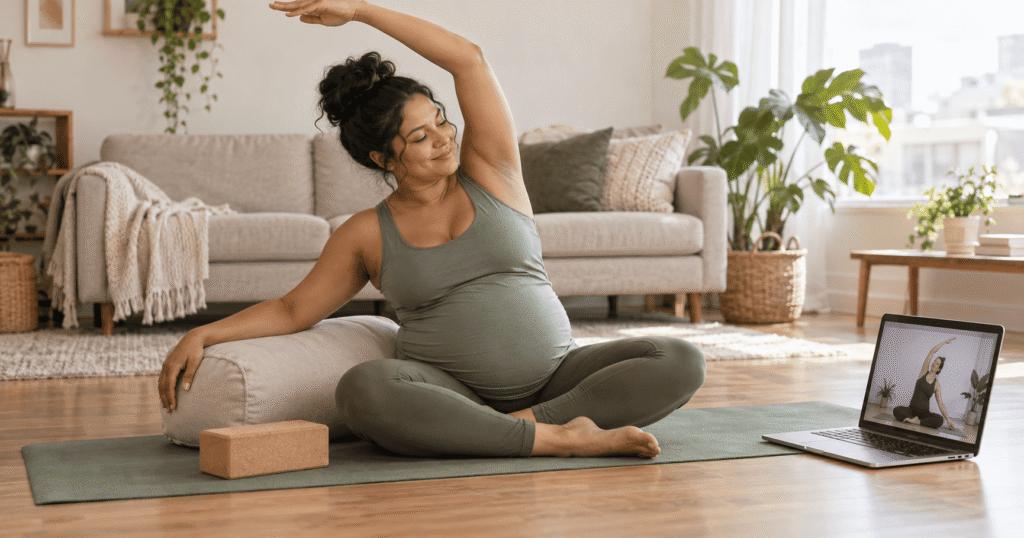
- No travel time or effort, which matters when you are tired or uncomfortable
- A familiar and comfortable environment where you can set up exactly as you need
- Flexible scheduling that fits around appointments, work and rest
- Live instructor guidance, not just a video to follow alone
- Access from anywhere in Calgary, across Canada or internationally
Canada Yoga Studio’s online yoga classes in Canada are available to students wherever they are located. Whether you live in central Calgary or a smaller town outside the city, you can access the same quality of live teaching without leaving your home.
How to Choose Prenatal Yoga Classes in Calgary
If you are comparing programs, here is a practical checklist to help you make a confident decision:
- Does the instructor have specific experience with pregnancy and prenatal yoga?
- Are classes adjusted by trimester with appropriate modifications?
- Is the program suitable for complete beginners?
- Are posture adjustments offered based on individual comfort?
- Is safe breathing guidance included?
- Do the class times work with your schedule and time zone?
- Is the total cost clear and reasonable?
- Are classes live or pre-recorded? Live classes offer personalised guidance.
- Is there personal instructor support during and between sessions?
- Is the enquiry and booking process straightforward?
Take time to ask questions before you commit. A good prenatal yoga program will welcome your questions and take your individual needs seriously.
Prenatal Yoga vs Regular Yoga
Prenatal yoga and general yoga are not the same practice. If you are pregnant, joining a standard yoga class without confirming that suitable modifications are available may not be appropriate.
Here is how they differ:
| Aspect | Prenatal Yoga | Regular Yoga |
| Postures | Modified for pregnancy | Standard postures |
| Balance support | Props and wall support used | Less emphasis on support |
| Abdominal work | Avoided or significantly modified | Often included |
| Twisting | Gentle and open twists only | Full range of twisting |
| Breathing | Calm and supportive techniques | May include more varied techniques |
| Pace | Slower and more restful | Varies widely |
| Props | Cushions, blocks and blankets used throughout | Used but less frequently |
| Trimester awareness | Central to every class | Not usually considered |
| Instructor training | Pregnancy-specific knowledge required | General yoga training |
If you are interested in general yoga after your pregnancy, Canada Yoga Studio’s Hatha Yoga Sessions offer a structured and accessible program for students at various levels. However, during pregnancy, prenatal yoga with an appropriate instructor is the recommended path.
What to Bring to Prenatal Yoga
For in-person classes or online sessions at home, having the right items ready makes your practice more comfortable:
- A supportive yoga mat with good grip
- Comfortable, loose-fitting clothing that allows movement
- A water bottle to stay hydrated throughout
- A small pillow or cushion for seated and lying-down postures
- A blanket for relaxation at the end of class
- Yoga blocks if you have them (though not essential)
- For online classes: a quiet space with enough room to extend your arms and legs safely
- A device positioned so the instructor can see you clearly
You do not need expensive equipment. A mat, something comfortable to wear and a cushion are enough to get started.
Prenatal Yoga for Partners and Expecting Families
Pregnancy is not only the experience of the person carrying the baby. Partners and families play an important role in creating a calm and supportive environment. While prenatal yoga is primarily practised by the pregnant person, partners can still be involved in meaningful ways:
- Practising relaxation and breathing exercises together at home
- Supporting a calm and restful atmosphere, especially before and after classes
- Learning about the breathing techniques being taught so they can offer encouragement
- Attending birth preparation discussions or partner-focused sessions if available
- Simply being present, patient and emotionally available during a physically demanding time
Good communication and a willingness to understand the physical and emotional changes of pregnancy make a real difference. Prenatal yoga often gives the pregnant person tools and language to describe what they are experiencing, which can improve how partners support them.
Postpartum Yoga After Childbirth
Once your baby arrives, your body enters a new recovery phase. Postpartum yoga is a separate and distinct practice focused on gradual, gentle recovery after childbirth. It is not the same as prenatal yoga, and the two should not be confused.
Postpartum Yoga after childbirth focuses on rebuilding core awareness, restoring pelvic floor function gently and supporting emotional recovery in a slow and thoughtful way. The right time to begin postpartum yoga depends on your recovery progress, the type of delivery you had and the advice of your healthcare provider.
Do not rush back into movement after having a baby. Rest, recovery and medical guidance come first.
Frequently Asked Questions
1. Is prenatal yoga safe for beginners?
Yes. Prenatal yoga is generally suitable for beginners. Classes are designed to be accessible regardless of previous yoga experience. Always inform your instructor that you are a beginner and get medical approval before starting.
2. When should I start prenatal yoga?
There is no fixed starting point. Many people begin in the second trimester, but some start earlier or later. The right time depends on your health, pregnancy stage and healthcare provider’s advice.
3. Can I practise prenatal yoga in the first trimester?
Some people do practise in the first trimester with medical approval. Classes at this stage are very gentle, focusing on breathing, light movement and rest. If you are experiencing significant nausea or fatigue, speak with your doctor before starting.
4. Can I do prenatal yoga in the third trimester?
Yes, with appropriate modifications and instructor guidance, prenatal yoga in the third trimester can be supportive. Classes focus on restorative movement, breathing and relaxation.
5. What are the benefits of prenatal yoga?
Prenatal yoga may support gentle mobility, posture awareness, breath control, relaxation, emotional well-being and a sense of community. Many students find it a valuable part of their self-care routine during pregnancy.
6. Is prenatal yoga different from regular yoga?
Yes. Prenatal yoga uses modified postures, slower pacing, pregnancy-specific breathing and trimester-appropriate guidance. It avoids movements that are not suitable during pregnancy.
7. Can I join prenatal yoga online from Calgary?
Yes. Canada Yoga Studio offers live online prenatal yoga classes accessible from Calgary and anywhere in Canada or internationally.
8. How much does prenatal yoga cost?
Canada Yoga Studio’s prenatal yoga program costs $150 per month.
9. How many sessions are included?
The program includes 12 live sessions over 30 days, with three sessions per week.
10. Do I need previous yoga experience?
No. The program is suitable for complete beginners as well as those with previous yoga experience.
11. What should I bring to an online prenatal yoga class?
A yoga mat, comfortable clothing, water, a cushion, a blanket and a quiet space with enough room to move safely. A device positioned so your instructor can see you is also helpful.
12. When should I stop prenatal yoga and contact my healthcare provider?
Stop your practice and seek medical advice immediately if you experience bleeding, fluid leakage, chest pain, fainting, severe dizziness, significant shortness of breath, painful contractions or any concerning change in your baby’s movements.
Final Thoughts
Finding the right support during pregnancy takes time, and choosing a movement practice that feels gentle, safe and genuinely welcoming is worth the effort. Prenatal yoga classes in Calgary do not need to be complicated or intimidating. The right class meets you exactly where you are, whether that is eight weeks pregnant and exhausted, or thirty weeks along and looking for some calm before a busy few weeks ahead.
Canada Yoga Studio’s Prenatal Yoga program offers live, instructor-led sessions available from the comfort of your home. With flexible timing, beginner-friendly teaching and trimester-specific modifications, it is designed to fit into real life during pregnancy.
If you are ready to take the next step, visit the program page, reach out with your questions and find out how to join. Your body and your pregnancy deserve thoughtful, caring support.