
Yoga for Sciatica Pain: Best Gentle Poses and Stretches for Relief

Introduction
If you are dealing with lower back discomfort, buttock pain or that familiar ache that travels down one leg, you are likely searching for something that feels both accessible and safe. Yoga for sciatica pain is one of the more common topics people explore when they want a gentle, low-impact option that fits into everyday life.
It is worth being clear from the start: gentle yoga and mindful stretching may support mobility, relaxation and body awareness for some people who experience sciatic discomfort. However, the right approach depends on the underlying cause, the severity of symptoms and the person’s overall health. What helps one person may not be suitable for another. Some movements can aggravate nerve symptoms if they are not chosen carefully or performed without proper guidance.
This article is written to give you practical, honest information about gentle yoga poses, common stretches and safe movement principles. If your symptoms are severe, worsening, or accompanied by weakness, numbness in the leg, or any changes in bladder or bowel function, please seek medical attention before starting any exercise routine.
At Canada Yoga Studio, beginner-friendly yoga guidance is available for people who want a slower and more mindful approach to movement. But first, let us walk through what sciatica is, what yoga may offer and which poses tend to feel accessible for beginners.
Quick Answer: Is Yoga Good for Sciatica?
Gentle yoga may help some people by supporting movement, reducing stiffness and encouraging relaxation. It is not a guaranteed treatment and individual results can vary considerably. Some poses may worsen symptoms if they increase nerve tension or put pressure on sensitive areas. People should move slowly, listen carefully to their body and stop if symptoms increase or spread further down the leg. Anyone with severe or persistent sciatica symptoms should seek advice from a healthcare professional before starting yoga.
What Is Sciatica?
Sciatica is a term used to describe symptoms that travel along the path of the sciatic nerve, which runs from the lower back through the buttock and down the back of each leg, sometimes reaching the foot. Most people experience sciatica on one side of the body.
Common symptoms that some people describe include:
- A dull ache or sharper pain in the lower back, buttock or leg
- Tingling or pins and needles sensations
- Numbness in the leg or foot
- A burning or electric feeling along the nerve path
- Leg weakness
- Discomfort that changes depending on posture, sitting or standing
It is important to understand that sciatica is a symptom rather than a single condition. The nerve can become irritated or compressed for different reasons, and the appropriate response depends on what is actually happening. A healthcare professional can assess the cause properly. Please do not use this article as a tool for self-diagnosis.
For many people, mild sciatic discomfort eases with time and appropriate movement. For others, ongoing or worsening symptoms need professional care.
Can Yoga Help Sciatica Pain?
This is a question many people ask, and the honest answer is: it depends.
Gentle yoga may offer a few potential benefits for some people with mild or occasional sciatic discomfort:
- Gentle movement may help reduce stiffness in the lower back and hips, which can feel tight when the body is guarding around a sore area.
- Controlled breathing can help reduce unnecessary tension throughout the body and make it easier to move without bracing.
- Gradual mobility work can support a person’s confidence with movement when they have been avoiding certain positions out of fear.
- Strengthening-focused movements, when appropriate, may support the muscles around the lower back and pelvis, which can be beneficial for overall physical function.
- Relaxation and body awareness can make it easier to notice how the body responds to movement and where individual limits are.
Research into yoga for lower back pain and sciatica shows mixed results, and individual responses can vary. Yoga should not replace assessment or care from a doctor, physiotherapist or another qualified healthcare professional. It is also worth noting that some yoga styles are not appropriate during an acute sciatica flare-up.
The best approach is to start gently, use modifications freely, and work with a qualified instructor who understands injury considerations.
Best Gentle Yoga Poses and Stretches for Sciatica
The following movements are commonly suggested as gentle starting points for people with mild sciatic discomfort. They are beginner-friendly, but they are not suitable for every person or every type of sciatica. Move slowly, stop if anything increases your symptoms and ask a healthcare professional if you are unsure.
When stretching, you should feel a mild, manageable sensation. Stop immediately if you notice sharp pain, burning nerve pain, electric sensations, increasing tingling or symptoms spreading further down the leg.
1. Supported Child’s Pose
What it involves: A resting position where you kneel on the floor and fold the torso forward over the thighs, with the arms extended or resting alongside the body.
Why it may feel helpful: For some people, this pose gently lengthens the lower back and creates a sense of decompression. It is a restful position that encourages slower breathing.
How to do it:
- Kneel on a yoga mat with knees hip-width apart or wider if that feels more comfortable.
- Sit your hips back towards your heels as far as feels comfortable.
- Rest your forehead on the mat or on a folded blanket.
- Extend your arms forward or rest them alongside your body.
- Breathe gently and allow the body to soften.
Modification: Place a bolster or folded blanket between your thighs and calves for support. You do not need to bring your forehead all the way to the floor.
Duration: Hold for 30 seconds to 2 minutes if comfortable.
When to stop: If you notice increasing pain, tingling or pressure in the lower back or legs, ease out of the pose slowly.
Note: Some people find this pose uncomfortable during an active flare-up. If that is the case, skip it and try a supine position instead.
2. Cat-Cow with a Small Range of Motion
What it involves: A slow, gentle spinal movement performed on hands and knees, alternating between a small arch and a gentle rounding of the back.
Why it may feel helpful: This movement may reduce stiffness in the spine and help some people reconnect with how their lower back moves. Keeping the range of motion small is key.
How to do it:
- Come onto hands and knees, with wrists under shoulders and knees under hips.
- Inhale slowly and allow the lower back to gently arch downward, lifting the head slightly. Keep this movement small.
- Exhale slowly and allow the back to gently round upward.
- Continue at a slow, comfortable pace.
Modification: Perform only the portion of the movement that does not increase symptoms. Even a very small range of motion can be beneficial.
Duration: Try 6 to 10 gentle repetitions.
When to stop: Stop if the arching or rounding increases pain, tingling or leg symptoms.
3. Pelvic Tilts
What it involves: A gentle movement lying on your back that involves tilting the pelvis slightly forward and back.
Why it may feel helpful: Pelvic tilts may support awareness of the lower back position and help release mild tension in the lumbar area. They are one of the gentlest movements for this region.
How to do it:
- Lie on your back with knees bent and feet flat on the floor, hip-width apart.
- Gently press the lower back into the floor by tightening the abdominal muscles slightly.
- Hold for 2 to 3 seconds, then release.
- Move slowly and with control.
Modification: Place a folded blanket under the head for comfort.
Duration: Try 8 to 12 slow repetitions.
When to stop: If you feel an increase in lower back or leg pain, stop.
4. Supine Figure Four Stretch
What it involves: Lying on your back and crossing one ankle over the opposite knee to gently stretch the outer hip and piriformis area.
Why it may feel helpful: For some people, tightness in the piriformis muscle near the buttock may contribute to sciatic discomfort. This gentle position may help release some of that tension. Individual responses vary.
How to do it:
- Lie on your back with both knees bent and feet on the floor.
- Cross your right ankle over your left thigh, keeping the right foot flexed.
- You may feel a mild stretch in the outer right hip. Stay here if that is enough.
- To increase the stretch slightly, lift both feet off the floor by gently drawing the left knee towards your chest.
Modification: Keep both feet on the floor and do not draw the knee in if that increases symptoms.
Duration: Hold for 30 to 60 seconds per side.
When to stop: If the stretch causes sharp pain, burning or worsening leg symptoms, release the position immediately.
5. Single Knee to Chest
What it involves: Gently drawing one knee towards the chest while lying on your back.
Why it may feel helpful: This movement may provide a mild stretch to the lower back and hip for some people. It can be a restful and accessible starting point.
How to do it:
- Lie on your back with both knees bent.
- Gently hold one knee with both hands and draw it slowly towards your chest.
- Keep the other foot flat on the floor.
- Hold gently without pulling forcefully.
Modification: Use a yoga strap looped around the back of the thigh instead of clasping the knee if that is more comfortable.
Duration: Hold for 20 to 40 seconds per side.
When to stop: Release if you feel increasing pain or leg symptoms.
6. Supported Bridge Pose
What it involves: Lying on your back and gently lifting the hips off the floor while pressing the feet into the mat.
Why it may feel helpful: This movement gently engages the glutes and lower back extensors. For some people, it may support pelvic stability and reduce lower back stiffness.
How to do it:
- Lie on your back with knees bent, feet flat and hip-width apart.
- Press through the feet and gently lift the hips a small amount off the floor.
- Keep the movement controlled and avoid pushing the hips too high.
- Lower slowly and repeat.
Modification: Place a yoga block under the sacrum (the flat bone at the base of the spine) for a supported, passive version. This can feel more restful than the active version.
Duration: Hold for 10 to 20 seconds or try 6 to 8 slow repetitions.
When to stop: Stop if you notice pain radiating into the leg or worsening lower back discomfort.
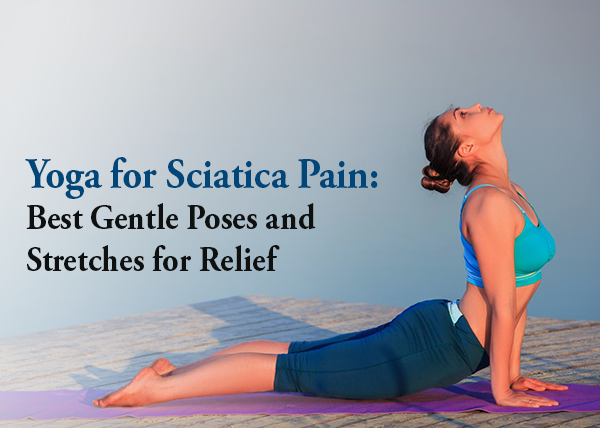
7. Gentle Sphinx Pose
What it involves: A supported, low-level backbend performed lying on the stomach, propped on the forearms.
Why it may feel helpful: For some people, a gentle extension of the lower back may reduce nerve compression and ease discomfort, depending on the cause. However, this pose is not suitable for everyone and should be tried cautiously.
How to do it:
- Lie face down with your legs extended behind you.
- Place your forearms on the mat with elbows under the shoulders.
- Gently press the forearms into the mat and allow the chest to lift slightly.
- Keep the lower body relaxed and breathe calmly.
Modification: Reduce the height by lowering onto the forearms further and keeping the lift very small.
Duration: Hold for 30 to 60 seconds if comfortable.
When to stop: If this position increases pain or causes symptoms to travel down the leg, lower yourself down and avoid this pose.
8. Reclined Hamstring Stretch with a Yoga Strap
What it involves: Lying on your back and gently straightening one leg upward, supported by a strap around the foot.
Why it may feel helpful: Tightness in the hamstrings can sometimes contribute to lower back and hip tension. A gentle, supported stretch may feel helpful for some people.
How to do it:
- Lie on your back with both knees bent.
- Loop a yoga strap around one foot.
- Gently extend that leg upward to a comfortable angle, keeping a slight bend in the knee.
- Do not force the leg straight if you feel nerve-related symptoms.
Modification: Keep the knee significantly bent and only raise the leg as far as feels comfortable without symptoms.
Duration: Hold for 20 to 40 seconds per side.
When to stop: If you feel burning, electric pain, or symptoms spreading down the leg, lower the leg immediately.
A Gentle 10-Minute Yoga Routine for Sciatica
This routine is suggested for people who have already been cleared for gentle movement by a healthcare professional, or for those who experience mild and occasional discomfort. Do not follow this routine if any movement increases your pain, numbness, tingling or weakness.
| Time | Movement |
| 1 minute | Relaxed breathing lying on your back |
| 1 minute | Pelvic tilts (slow and controlled) |
| 2 minutes | Gentle Cat-Cow with a small range of motion |
| 2 minutes | Single Knee to Chest (both sides) |
| 2 minutes | Supine Figure Four Stretch (both sides) |
| 1 minute | Supported Bridge Pose or a comfortable rest position |
| 1 minute | Relaxation, lying still and breathing slowly |
Important note: This is not a treatment plan. If any movement increases pain, causes tingling to spread or makes you feel worse, stop and rest. Speak with a healthcare professional if symptoms do not settle.
Yoga Poses and Movements to Modify or Avoid
Some movements may aggravate sciatic symptoms for certain people, particularly during a flare-up. This does not mean these movements are always unsafe, but the right choice depends on the individual and their symptoms.
Use caution with the following:
- Deep forward folds: These can increase tension along the sciatic nerve for some people, particularly if the hamstrings are tight.
- Forced hamstring stretches: Stretching the leg forcefully while the nerve is irritated can increase discomfort.
- Aggressive spinal twists: Sharp rotation of the lower spine may increase nerve irritation in some cases.
- Deep hip stretches: Extreme hip positions may compress or pull on the nerve depending on the cause of symptoms.
- Fast transitions between poses: Moving quickly between positions can put sudden load through a sensitive area.
- Strong backbends: Deep extension of the lower back is not appropriate for all types of sciatica.
- Holding a painful pose: If a movement causes discomfort from the beginning, holding it longer will not improve the situation.
- Stretching into numbness or tingling: This is a warning sign, not a sign of progress.
- Repeatedly rounding the lower back when it increases symptoms: Some people find that flexion-based movements make symptoms worse.
If you are unsure whether a movement is appropriate for your situation, speak with a physiotherapist or qualified yoga instructor before including it in your practice.
How to Practise Yoga Safely with Sciatica
Practising carefully makes a significant difference, particularly at the beginning. Here is a practical checklist to keep in mind:
- Start with short sessions and see how the body responds.
- Warm up gradually with breathing and small movements before attempting stretches.
- Keep all movements slow and controlled.
- Use props freely: blocks, bolsters, blankets, yoga straps and chairs are tools, not shortcuts.
- Keep the spine in a comfortable and supported position.
- Avoid bouncing or pushing into a stretch suddenly.
- Breathe naturally and continuously. Holding the breath is a sign of strain.
- Stop if symptoms travel further down the leg.
- Stop if you notice new or worsening numbness, tingling, weakness or sharp pain.
- Give the body time to respond before increasing the intensity or duration of practice.
- Ask a qualified instructor for modifications when attending a class.
Understanding the difference between a stretch and a nerve symptom:
A mild stretch may feel like a gentle pulling sensation that is manageable and fades when you ease out of the position. Nerve-related symptoms feel different: burning sensations, electric shooting pain, increasing tingling or numbness spreading further are all warning signs to stop. Do not push through these sensations.
When Should You Avoid Yoga and See a Healthcare Professional?
Some symptoms require prompt medical attention and should not be managed with yoga or self-directed stretching. Please seek medical advice if you experience any of the following:
- Severe or rapidly worsening pain
- Progressive weakness in the leg or foot
- New or worsening numbness
- Difficulty walking, standing or bearing weight
- Loss of bladder or bowel control
- Numbness around the inner thighs, groin or the saddle area of the body
- Symptoms following a serious fall, collision or accident
- Back pain with fever or generally feeling unwell
- Unexplained weight loss alongside back pain
- A history of cancer, osteoporosis or serious illness where back pain appears
- Symptoms that keep returning or do not respond to gentle care
Yoga is not a substitute for medical diagnosis, physiotherapy or appropriate healthcare. If you are unsure whether yoga is suitable for your specific situation, please speak with a doctor or physiotherapist before starting any exercise programme. This is especially important if your symptoms are persistent, worsening or affecting daily function.
Yoga for Sciatica in Calgary: Choosing the Right Class
If you are based in Calgary and considering joining a yoga class to support your movement, it helps to know what to look for. Not every class will suit someone who is managing lower back or sciatic discomfort, so it is worth choosing thoughtfully.
Look for classes that offer:
- Beginner-friendly instruction with clear verbal and visual cues
- Slow, controlled sequences without sudden transitions
- Modification options for every pose
- Small group sizes or personalised guidance where possible
- Instructors who ask about injuries and limitations before the class begins
- No pressure to achieve advanced poses or match other participants
- Options for online participation if attending in person is not convenient
- A session format that fits with your schedule and energy levels
Gentle yoga classes in Calgary vary in style and pace, so it is always a good idea to contact the studio beforehand and explain your situation. A good instructor will be happy to guide you toward a session that fits your needs.
Canada Yoga Studio’s Relevant Yoga Options
For people who prefer a slower, more foundational approach to yoga, Canada Yoga Studio offers Hatha Yoga Sessions that focus on steady, mindful movement and breath awareness. Hatha yoga is often considered one of the more accessible styles for beginners and for those who prefer a calmer pace.
The Hatha programme at Canada Yoga Studio includes:
- Live online sessions delivered through Google Meet
- 8 sessions over 30 days
- Flexible scheduling to suit different time zones
- Two sessions per week
- Available for $80 per month
Hatha yoga is a gentle, traditional style and may feel accessible for people who want to build body awareness gradually. It is not presented as a treatment for sciatica, and individual suitability depends on your current symptoms and health.
If you are currently experiencing pain or discomfort, please inform the instructor before joining a session. Ask about available modifications and whether the class format is appropriate for your situation.
Online Yoga for Back Pain and Mobility
For people who prefer to practise from home, online yoga offers a number of practical advantages:
- No travel required, which can be helpful when sitting or driving is uncomfortable
- The comfort and familiarity of your home environment
- The ability to use household furniture such as a chair or wall for additional support
- Easier scheduling around work, family and rest
- Personal space to move slowly without feeling observed
- Convenient access for Calgary residents and people across Canada
Canada Yoga Studio’s online yoga classes in Canada provide a flexible option for those who want guided instruction without needing to attend in person.
Online yoga is not automatically safer than in-person instruction. If anything, having an instructor who can observe your movement and offer corrections in real time can be particularly valuable. If you are joining online, try to position your device so the instructor can see you clearly and offer guidance where needed.
How Often Should You Practise Yoga for Sciatica?
There is no universal answer to this question, and it is not something that should be approached the same way by every person.
What tends to be more useful than a fixed number is consistency with a small amount rather than an intense occasional session. For many beginners, starting with two or three short, gentle sessions per week and paying close attention to how the body responds during practice and over the following day is a sensible approach.
If a session leaves you feeling sore, more stiff or with increased nerve symptoms, that is information worth noting. It may mean the session was too long, the movements were too intense or specific poses were not suitable.
A qualified yoga instructor or physiotherapist can help you decide what is appropriate for your individual situation. Do not increase intensity or duration quickly. Give the body time to respond.
Comparison Table: Movement Types at a Glance
| Movement Type | Possible Purpose | Beginner Modification | When to Stop |
| Gentle mobility (e.g., Cat-Cow, pelvic tilts) | May reduce stiffness and support spinal awareness | Use a very small range of motion | Stop if pain or leg symptoms increase |
| Supported stretching (e.g., Figure Four, knee to chest) | May reduce tension in the hips and lower back for some people | Keep feet on the floor, avoid pulling hard | Stop if tingling, burning or numbness worsens |
| Core and pelvic awareness (e.g., pelvic tilts, supported bridge) | May support lower back stability when performed gently | Use a block under the sacrum for passive support | Stop if lower back or leg pain increases |
| Relaxation breathing | May support reduced muscle tension and body awareness | Lie comfortably on your back with knees bent | There is no reason to stop unless the position is uncomfortable |
| Deep stretching (e.g., strong hamstring or hip stretches) | Not generally recommended during active flare-ups | Use a strap and keep a strong bend in the knee | Stop at the first sign of nerve-related symptoms |
FAQs
Can yoga help sciatica pain?
Yoga for sciatica pain may help some people by supporting gentle mobility, reducing stiffness and encouraging relaxation. It is not a guaranteed treatment and individual responses vary. Gentle, beginner-friendly movements are more likely to feel beneficial than advanced or forceful stretching. Anyone with severe or persistent symptoms should speak with a healthcare professional before starting yoga.
What is the best yoga pose for sciatica?
There is no single best pose because the most suitable movements depend on the cause and severity of symptoms. Gentle options that some people find helpful include the Supine Figure Four Stretch, Single Knee to Chest and Supported Child’s Pose. These should be performed slowly and modified to suit individual comfort.
Which stretches are good for sciatic nerve pain?
Stretches for sciatic nerve pain that are commonly suggested for beginners include the Figure Four hip stretch, reclined hamstring stretch with a strap and gentle spinal movements such as Cat-Cow. All stretches should be performed with a mild, comfortable sensation rather than pushing into sharp or nerve-like pain.
Should I stretch if my sciatica is flaring up?
During an active flare-up, it is generally advisable to rest, avoid aggravating movements and consult a healthcare professional before doing any stretching. Gentle breathing and very small, comfortable movements may be manageable for some people, but forcing stretches during a flare-up can worsen symptoms. Listen to your body carefully.
Can yoga make sciatica worse?
Yes, certain yoga movements can increase sciatic symptoms if they are not appropriate for the individual or the cause of their symptoms. Deep forward folds, aggressive twists and forced hamstring stretches are among the movements that may worsen nerve pain for some people. Practising with qualified guidance and stopping at the first sign of worsening symptoms reduces this risk.
Is Child’s Pose good for sciatica?
Supported Child’s Pose may feel comfortable and restful for some people with mild sciatic discomfort. For others, it may cause compression or increased nerve tension in the lower back or legs. It is worth trying gently with modifications and stopping immediately if symptoms worsen.
Is the Figure Four stretch safe for beginners?
The Supine Figure Four Stretch is generally considered accessible for beginners when performed carefully on the floor with both feet on the mat. It should be approached slowly and never forced. If it causes sharp pain or worsens leg symptoms, it should be avoided.
What exercises should be avoided with sciatica?
Movements that may aggravate sciatica for some people include deep forward bends, aggressive spinal twists, heavy weighted exercises for the lower back, high-impact activity and any movement that causes shooting, burning or electric pain down the leg. The appropriate list of movements to avoid depends on the individual’s diagnosis and symptoms.
Can I do yoga with a herniated disc?
Some people with a herniated disc are able to practise gentle yoga with appropriate modifications. However, this depends on the severity and location of the disc issue and the guidance of a treating healthcare professional. Not all yoga poses are suitable in this situation. Medical clearance and qualified instruction are particularly important.
How often should I practise yoga for sciatica?
Starting with two or three gentle sessions per week and observing how the body responds is a sensible approach for many beginners. Consistency with a manageable amount is more beneficial than long, intense sessions. A qualified instructor or physiotherapist can help decide what is appropriate for your individual needs.
Should I see a doctor before starting yoga?
If you are experiencing significant pain, weakness, numbness or symptoms that are new or worsening, speaking with a doctor or physiotherapist before starting yoga is advisable. Even for mild and occasional discomfort, a brief check-in with a healthcare professional can help ensure the movements you choose are appropriate.
Can I join online yoga classes with back pain?
Online yoga classes can be a convenient option for people with mild back discomfort who want to practise at home. Choosing a beginner-friendly class, informing the instructor about your situation and having appropriate props available can all support a safer experience. Online yoga for people in Calgary and across Canada is available through Canada Yoga Studio.
Are yoga classes in Calgary suitable for beginners?
Yes, beginner-friendly yoga classes are available in Calgary for people who want to start at a slower pace. Gentle yoga classes in Calgary, such as those offered through Canada Yoga Studio, provide a structured introduction to foundational movements. It is always worth contacting the studio before joining to discuss your experience and any current physical limitations.
Conclusion
Yoga for sciatica pain can be a gentle and practical tool for some people who are looking to support their mobility, manage stiffness and move with more ease. The movements covered in this article are designed to be accessible, low-impact and beginner-friendly, but it is important to remember that no single routine or stretch works the same way for every person.
The underlying cause of sciatic discomfort matters. What helps one person may not be appropriate for another, and some movements can increase symptoms if they are not matched carefully to individual needs. Stretching should never be forced, and any sign of worsening nerve symptoms, such as spreading tingling, burning or increasing weakness, is a signal to stop and seek guidance.
If symptoms are severe, persistent or associated with any of the red flags mentioned in this article, please speak with a doctor or physiotherapist rather than relying on self-directed yoga.
For those who are ready to explore gentle movement in a supportive environment, practising with proper guidance can make a meaningful difference in how confident and comfortable you feel with your body.
If you are looking for a slower and more mindful way to practise yoga in Calgary or online, Contact Canada Yoga Studio to discuss your experience, movement needs and suitable class options. The team can help point you toward a session format that respects where you are right now.