
5 Elements of Hatha Yoga for Beginners

Introduction
If you are new to yoga and have heard the phrase “5 Elements of Hatha Yoga,” you might be wondering what it actually means and whether it matters for someone just starting out. The short answer is that these five elements, drawn from traditional yoga philosophy, offer a clear and practical way to understand the qualities you experience during a Hatha Yoga practice. Qualities such as stability, fluidity, energy, movement and stillness.
You do not need a background in philosophy or years of experience to appreciate this framework. Whether you are stepping onto a mat for the very first time, or you are exploring yoga options in Calgary or elsewhere in Canada, understanding these five elements can give your practice more depth and direction from the very beginning.
Canada Yoga Studio is a Calgary-based yoga studio offering both in-studio and live online Hatha Yoga sessions. Their beginner-friendly approach makes it straightforward for new students to explore the fundamentals of yoga at their own pace.
Quick Answer: What Are the Five Elements of Hatha Yoga?
The five elements of Hatha Yoga come from a traditional yogic concept called the Pancha Mahabhutas, which means “five great elements” in Sanskrit. They are Earth (Prithvi), Water (Jala), Fire (Agni), Air (Vayu) and Space (Akasha). In Hatha Yoga, these elements are used as a philosophical framework to explore qualities such as stability, fluidity, energy, breath awareness and stillness. Interpretations may differ between yoga traditions and lineages.
What Is Hatha Yoga?
Hatha Yoga is one of the most widely practised styles of yoga across Canada and around the world. The word “Hatha” is often translated as a combination of “Ha” (sun) and “Tha” (moon), representing the balance of effort and ease within the practice.
At its core, Hatha Yoga includes:
- Asana: Physical postures that build strength, flexibility, balance and body awareness.
- Pranayama: Breath awareness and guided breathing practices that help calm the nervous system and improve focus.
- Alignment and mindful movement: Understanding how to position the body safely and comfortably in each posture.
- Concentration: Bringing the mind’s attention to the present moment, the posture or the breath.
- Relaxation: Taking time between postures and at the end of class to allow the body to settle.
- Meditation: A period of quiet observation, often practiced toward the end of a session.
- Gradual progression: Building from simple foundational poses toward more complex movements over time.
Modern Hatha Yoga classes can vary depending on the instructor and the lineage they follow. Some classes move slowly with long holds, while others include a gentle flow. What tends to stay consistent is a steady pace that gives students time to understand each posture, connect with the breath and develop body awareness.
Hatha Yoga does not require prior experience, and flexibility is not a requirement to begin. The practice is designed to meet you where you are.
The Five Elements of Hatha Yoga Explained
The Pancha Mahabhutas, or five great elements, are a foundational concept in traditional Indian philosophy and yogic thought. They describe qualities found in nature and within human experience. It is important to understand that these are philosophical ideas, not scientific classifications. Different yoga schools and traditions may interpret or apply these elements in different ways. The table below offers a simple overview before we explore each one in more detail.
Overview Table: The Five Elements in Hatha Yoga
Note: This table represents a traditional yoga philosophy framework. It is not a scientific classification or medical system.
| Element | Traditional Quality | Beginner Practice Focus | Example |
| Earth (Prithvi) | Stability, grounding, strength | Building a steady physical foundation | Mountain Pose, Warrior I |
| Water (Jala) | Fluidity, adaptability, ease | Moving smoothly without force | Cat Cow, gentle hip mobility |
| Fire (Agni) | Energy, focus, discipline | Building gentle effort and concentration | Gentle Sun Salutation, Chair Pose |
| Air (Vayu) | Movement, breath, lightness | Connecting breath with movement | Breathing practices, side stretches |
| Space (Akasha) | Stillness, awareness, openness | Creating room for rest and observation | Savasana, meditation, quiet pauses |
Element 1: Earth (Prithvi)
In traditional yoga philosophy, the Earth element represents qualities such as stability, grounding, strength and solid support. It reflects the sense of being rooted and secure, much like the ground beneath your feet.
In a beginner Hatha Yoga class, the Earth quality is often experienced through:
- Mountain Pose (Tadasana), where you stand tall with feet firmly planted
- Warrior variations, where the legs and feet create a strong base
- Chair-supported standing postures for those who need extra support
- Comfortable seated postures on the mat or on a folded blanket
- Slow balance work that encourages steadiness rather than performance
How to practise the Earth quality as a beginner:
- Feel the contact between your feet and the floor before moving into a posture.
- Build alignment gradually without rushing through the steps.
- Avoid moving quickly between poses. Take a moment to settle into each one.
- Use props such as blocks, blankets or a chair to make postures accessible.
- Focus on stability rather than how the posture looks.
The Earth element is a reminder that a strong practice begins with a solid foundation.
Element 2: Water (Jala)
Water in traditional yogic thought represents fluidity, adaptability, ease and smooth movement. It reflects the quality of flowing without resistance, adjusting to whatever shape is needed.
In Hatha Yoga, the Water quality appears through:
- Gentle hip mobility exercises that allow the joints to move freely
- Cat Cow movements that create a rhythmic wave through the spine
- Side stretches that lengthen the body without forcing the range of motion
- Slow, considered transitions between postures
- Comfortable flowing sequences that feel natural rather than mechanical
For beginners, the Water element encourages you to approach the practice without stiffness or unnecessary effort. If a posture does not feel right, the water quality invites you to find an easier variation rather than pushing through discomfort.
This does not mean the practice should feel effortless in every moment. It means you move with awareness and avoid forcing the body into shapes it is not ready for.
Element 3: Fire (Agni)
Fire in traditional yoga philosophy represents energy, discipline, focus, motivation and inner warmth. It is the quality that sustains your effort and keeps you present throughout the practice.
In beginner Hatha Yoga, the Fire quality is explored through:
- Gentle Sun Salutation variations adapted for beginners
- Core awareness, understanding how the centre of the body supports movement
- Chair Pose modifications that build leg strength gradually
- Steady posture holds that require focus and patience
- Deliberate, focused breathing during effort
The Fire element is not about pushing harder or moving faster. For beginners, it is about finding your own level of consistent effort and maintaining it with awareness. Build intensity over time, class by class, rather than in one session.
A common misconception is that Fire in yoga should feel intense or uncomfortable. In a well-paced beginner class, it simply means showing up with intention and giving your attention fully to the practice.
Element 4: Air (Vayu)
In traditional yogic thought, the Air element represents movement, breath, lightness, change and mental awareness. It reflects the quality of the breath and its connection to the movement of the body and the activity of the mind.
In Hatha Yoga for beginners, the Air quality appears through:
- Natural, comfortable breathing throughout the practice
- Coordinating the breath with movement, such as inhaling to lengthen and exhaling to fold
- Gentle pranayama, or breathing practices, that introduce breath awareness without complexity
- Side-body stretching that creates a sense of openness through the ribcage
- Mindful transitions between postures, where the breath guides the pace
As a beginner, never force the breath. If a breathing exercise feels uncomfortable, return to your natural rhythm. Advanced breath retention techniques should only be explored with a qualified instructor, once a solid foundation is established.
The Air element is a reminder that the breath is always available as an anchor for attention. When the mind wanders, returning to the breath brings you back to the present moment.
Element 5: Space (Akasha)
Space is the most subtle of the five elements in traditional yoga philosophy. It represents stillness, awareness, openness and the quality of inner attention. In practical terms, it is the pause between movements, the silence between thoughts and the sense of rest that follows effort.
In Hatha Yoga, the Space quality appears through:
- Meditation at the end of a session
- Savasana, the final relaxation posture
- Quiet observation of thoughts and sensations without reacting
- Mindful pauses between postures
- Breath awareness during relaxation
Space is not about doing more. It is about creating room for the body and mind to integrate what has been practised. Many beginners skip Savasana or meditation because they feel they should be doing something. Resting with awareness is a genuine and valuable part of the practice.
Space also reflects the broader quality of mental openness. As you become more familiar with Hatha Yoga, you may notice that creating space in your practice begins to feel natural rather than unfamiliar.
How the Five Elements Work Together in Hatha Yoga
The five elements are not five separate exercises that must be completed one by one. They are qualities that can appear throughout a single class, sometimes overlapping and sometimes taking turns as the focus shifts.
Here is a simple example of how the five elements might appear in a 30 to 45-minute beginner Hatha Yoga class:
- Earth appears during standing postures, when you take time to feel grounded and stable before moving.
- Water appears during Cat Cow and gentle mobility work, when the body moves fluidly through its natural range.
- Fire appears during a gentle Sun Salutation or a standing pose held for several breaths, when sustained effort and focus are required.
- Air appears throughout the class, as the breath guides transitions, lengthens the posture and settles the mind.
- Space appears at the end, during a short meditation or Savasana, when the practice moves inward.
Not every class will follow this exact structure. The five elements are a lens through which to understand what is happening in your practice, not a strict sequence that every yoga teacher follows.
Beginner Hatha Yoga Sequence Based on the Five Elements
This is a sample sequence designed for beginners. It is a general educational guide, not a personalised programme. Please read the safety notes at the end before beginning.
1. Comfortable Seated Breathing (Air)
Sit in a comfortable position on a chair or folded blanket. Close the eyes and take several slow, natural breaths. Notice the rhythm of the inhale and exhale. Beginner focus: settle into the space and bring attention to the breath.
2. Mountain Pose, Tadasana (Earth)
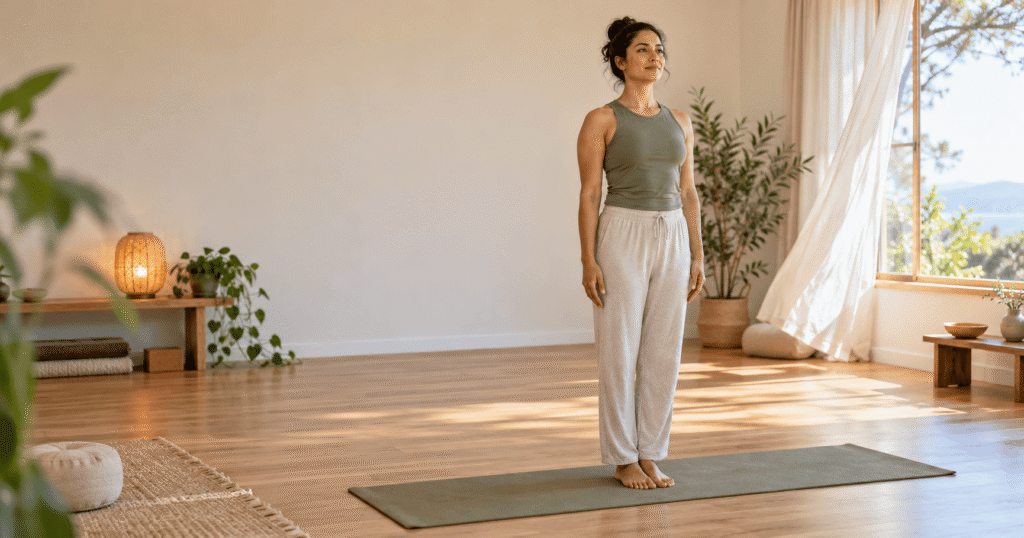
Stand with feet hip-width apart. Feel the feet on the floor. Lengthen the spine and relax the shoulders. Beginner focus: build a steady, upright foundation without tension.
3. Cat Cow, Marjaryasana and Bitilasana (Water)
On hands and knees, alternate between arching and rounding the spine with each breath. Move at your own pace. Beginner focus: allow the spine to move freely and comfortably.
4. Gentle Sun Salutation (Fire)
A simplified version with modified postures. Move at a pace that allows steady breathing. Beginner focus: maintain focus and consistent effort without rushing.
5. Warrior I or Supported Warrior Variation (Earth and Fire)
Step one foot forward into a wide stance. Bend the front knee comfortably. Use a chair for support if needed. Beginner focus: strength and stability through the legs and feet.
6. Seated Side Stretch (Air and Water)
Sit comfortably on the mat or a chair. Extend one arm overhead and lean gently to the opposite side. Beginner focus: create space through the side body and coordinate with the breath.
7. Simple Seated Forward Fold (Water and Space)
From a seated position, gently hinge at the hips and fold forward. Use a strap or bend the knees as needed. Beginner focus: ease and gentle release without force.
8. Easy Meditation (Space and Air)
Sit comfortably and observe the breath for three to five minutes. Notice thoughts without following them. Beginner focus: stillness and quiet awareness.
9. Savasana (Space)
Lie on the back with arms slightly away from the body. Stay for five minutes. Beginner focus: complete rest and integration.
Safety instructions:
- Move slowly and listen to your body throughout.
- Never force a posture. If something feels sharp or uncomfortable, ease out of it.
- Keep breathing comfortably at all times.
- Use a wall, chair, block or blanket whenever you need support.
- Stop if you feel sharp pain, dizziness or unusual discomfort.
- Ask a qualified instructor for modifications suited to your body and any health concerns.
Benefits of Learning the Five Elements as a Beginner
Understanding the five elements as a philosophical framework, rather than as rules to follow, can add genuine value to a beginner’s practice. Here are some general benefits that many practitioners find when exploring this approach:
- Better body awareness: Paying attention to qualities such as grounding or fluidity can help you notice how your body feels during and after practice.
- Improved focus: Having a clear quality to explore in each posture, such as steadiness or ease, may support concentration during class.
- More mindful breathing: The Air element naturally draws attention to the breath, which can help some people feel calmer and more present.
- A structured way to understand yoga philosophy: For beginners who are curious about the deeper layers of yoga, the five elements offer an accessible starting point.
- Greater appreciation of balance between effort and rest: Learning when to apply effort (Fire) and when to allow stillness (Space) can improve consistency and reduce strain.
- More awareness of transitions: Thinking about Water quality during transitions can encourage smoother, safer movement between postures.
- A calmer approach to movement: Many practitioners find that approaching practice with a philosophical framework reduces the tendency to compete or rush.
Individual experiences may vary. With regular and suitable practice, these benefits tend to develop gradually over time.
Common Beginner Mistakes
Starting yoga with awareness of common mistakes can make a significant difference to your experience and progress.
- Treating the five elements as literal science. The Pancha Mahabhutas are part of traditional yoga philosophy. They are not a scientific model of the body or a medical system.
- Trying to force advanced poses too soon. Build postures gradually and accept where your body is today.
- Holding the breath. Breath retention without instruction is unnecessary in beginner classes and can cause dizziness.
- Focusing only on flexibility. Yoga includes strength, balance, breath awareness and mental focus. Flexibility is one aspect, not the goal.
- Comparing yourself with other students. Every body is different. Progress is personal.
- Skipping relaxation and Savasana. Rest is part of the practice. Skipping it reduces the benefit of the session.
- Moving too quickly through postures. Speed reduces alignment awareness and increases the risk of discomfort.
- Assuming one yoga style suits everyone. Different classes, teachers and lineages vary. Try a few before deciding what works for you.
- Following online instructions without considering your limitations. Always check with a qualified instructor if you have injuries or health conditions.
- Treating yoga as a replacement for healthcare. Yoga can support general well-being as part of a balanced lifestyle. It is not a substitute for medical advice or treatment.
Is Hatha Yoga Suitable for Beginners?
Yes, Hatha Yoga can be a very suitable starting point for beginners, particularly when the class is appropriately paced and clearly guided.
A good beginner Hatha Yoga class should include:
- Clear, step-by-step instructions for each posture
- Foundational postures that build confidence before moving to more complex movements
- Breath awareness integrated throughout the session
- Beginner modifications for every posture
- Comfortable pacing with time to settle and adjust
- Space for questions and individual attention
- Respect for different body types, abilities and limitations
- No pressure to perform advanced postures or match other students
One of the most common concerns among beginners is that they are not flexible enough for yoga. Flexibility is not required to start. The practice itself develops body awareness gradually over time.
Canada Yoga Studio’s Hatha Yoga Sessions
Canada Yoga Studio offers a beginner-friendly Hatha Yoga programme designed to introduce students to the foundations of the practice in a clear and supportive way.
Here is what the programme includes:
- Live online sessions through Google Meet, making it accessible from anywhere in Canada
- Eight sessions over 30 days, with two classes per week
- Flexible timing based on the student’s time zone
- Sessions covering posture foundations, breath awareness, mobility, strength, balance, relaxation and meditation
- A monthly cost of $80
The programme is designed for people who want to understand Hatha Yoga properly from the beginning, rather than jumping into an advanced class unprepared.
Explore the full details on the Hatha Yoga Sessions page.
Online Hatha Yoga for Calgary and Canada
Online Hatha Yoga classes offer a practical option for many beginners, particularly for those living in Calgary or other parts of Canada where travel to a studio may not always be convenient.
Some reasons why online classes may suit beginners:
- Practise from the comfort of your own home
- No travel time or cost involved
- Flexible timing that can fit around work and family schedules
- Easier access for students across Calgary and across Canada
- Freedom to use a chair, wall or props without feeling self-conscious
- A comfortable, familiar environment for first-time students
Online classes are not automatically better or safer than in-person sessions. Both formats have their place. What matters most is the quality of instruction and the suitability of the class for your level.
Find out more about online yoga classes in Canada through Canada Yoga Studio.
How to Choose the Right Hatha Yoga Class in Calgary
Whether you are searching for Hatha Yoga in Calgary specifically or looking for online options across Canada, it helps to ask a few clear questions before committing to a programme.
Use this checklist when evaluating a class or studio:
- Are beginners genuinely welcome, or is it a mixed-level class that assumes prior experience?
- What does the class include? Postures only, or also breathing and relaxation?
- Is the class online, in studio, or both?
- Are modifications available for different body types and limitations?
- What is the pace of the class?
- Does the teacher explain alignment clearly and check in with students?
- Does the programme avoid promises of instant results or dramatic changes?
- Is the schedule realistic for you to follow consistently?
- Is there an opportunity to share health concerns or injuries before beginning?
Canada Yoga Studio is one option worth considering for people looking for guided Hatha Yoga in Calgary or online. The programme is structured, accessible and focused on building a genuine foundation in the practice.
Frequently Asked Questions
What are the five elements of Hatha Yoga?
The five elements of Hatha Yoga refer to the traditional yogic concept of the Pancha Mahabhutas: Earth (Prithvi), Water (Jala), Fire (Agni), Air (Vayu) and Space (Akasha). These elements describe qualities of experience such as stability, fluidity, energy, movement and awareness. They are used in some yoga traditions as a philosophical framework for understanding the practice. Interpretations vary between different lineages and teachers.
What are the five elements in yoga philosophy?
In yoga philosophy, the five elements come from the Pancha Mahabhutas, a concept found in ancient Indian philosophical traditions including Samkhya and Ayurveda. Earth represents solidity, Water represents fluidity, Fire represents energy and transformation, Air represents movement and breath, and Space represents openness and awareness. These are philosophical categories, not scientific measurements.
Are the five elements scientifically proven?
No. The five elements are part of traditional yoga philosophy and ancient Indian thought. They are not a modern scientific classification of matter or human anatomy. They describe qualitative experiences and philosophical principles. Approaching them as a philosophical lens rather than a factual framework helps beginners engage with them in a balanced and honest way.
Is Hatha Yoga good for beginners?
Hatha Yoga can be a very suitable style for beginners. It is generally practised at a steady, accessible pace and tends to include foundational postures, breath awareness, alignment guidance and relaxation. With the right instructor and a class designed for beginners, most people can start without prior experience or flexibility. Individual suitability depends on the specific class, instructor and the student’s health and needs.
What is the difference between Hatha Yoga and the five elements?
Hatha Yoga is a style of yoga that includes postures, breathing practices, alignment, concentration, relaxation and meditation. The five elements are a philosophical concept from traditional yoga thought that some teachers use as a framework to explore different qualities within the practice. The five elements are not the same as the eight limbs of yoga, the five koshas or the yamas and niyamas, which are separate concepts within yoga philosophy.
How are Earth and Water represented in yoga?
Earth is represented through grounding, stability and strength. In practice, this often appears in standing postures and balance work, where the feet connect firmly with the floor. Water is represented through fluidity, ease and smooth movement. It appears in gentle mobility work, spinal movements like Cat Cow and slow transitions between postures. Both qualities complement each other throughout a beginner class.
What does Fire represent in Hatha Yoga?
Fire represents energy, focus, discipline and sustained effort. In Hatha Yoga, this quality appears when you hold a posture for several breaths, maintain concentration during a Sun Salutation or build gentle core awareness. For beginners, Fire is about consistent and mindful effort, not intensity or strain. It is the quality that keeps you engaged and present throughout the practice.
Why is breath connected with the Air element?
In traditional yoga philosophy, Air represents movement, breath and the quality of lightness. The breath is the most direct experience of movement within the body, making it a natural expression of the Air element. In Hatha Yoga, coordinating the breath with movement and practising simple breathing exercises are foundational skills. The breath also connects the physical practice with the quieter, more meditative aspects of yoga.
What does Space mean in yoga?
Space (Akasha) is the subtlest of the five elements. In yoga, it represents stillness, openness and inner awareness. In practice, Space appears during Savasana, meditation and the mindful pauses between postures. It is not about adding more activity. It is about allowing the body and mind to settle, integrate and rest. Many beginners underestimate the importance of Space in a balanced practice.
What are the basic Hatha Yoga poses for beginners?
Common beginner Hatha Yoga poses include Mountain Pose (Tadasana), Cat Cow (Marjaryasana and Bitilasana), Warrior I (Virabhadrasana I), Seated Forward Fold, Child’s Pose (Balasana) and Savasana. These postures build foundational strength, flexibility and body awareness. A qualified instructor can provide modifications for each posture based on individual needs and limitations.
Can I learn Hatha Yoga online?
Yes. Online Hatha Yoga classes can be a practical and accessible option for many beginners. Canada Yoga Studio offers live online sessions through Google Meet, which are available to students across Canada regardless of location. As with any form of instruction, the quality of the teacher and the structure of the class matter more than the format.
Are Hatha Yoga classes available in Calgary?
Yes. Canada Yoga Studio is a Calgary-based studio offering both in-studio and live online Hatha Yoga sessions. Their beginner programme is designed for people new to yoga in Calgary and across Canada, with flexible scheduling and a clear focus on foundations, breath awareness and safe progression.
How often should a beginner practise Hatha Yoga?
For most beginners, practising two to three times per week is a reasonable starting point. This allows the body time to adjust and recover between sessions while still building a consistent habit. Canada Yoga Studio’s beginner programme includes two sessions per week over 30 days, which provides a structured and sustainable pace for new students.
Conclusion
The 5 elements of Hatha Yoga, Earth, Water, Fire, Air and Space, offer a traditional and thoughtful framework for understanding the many qualities that a yoga practice can explore. They come from ancient yogic philosophy rather than modern science, and different teachers and traditions may apply them in different ways. What makes them valuable for beginners is the clarity they bring.
When you approach your practice with awareness of grounding, fluidity, effort, breath and stillness, each class becomes more than a series of postures. It becomes an opportunity to understand the body, the mind and the breath in a connected and meaningful way.
You do not need to memorise philosophy to benefit from this approach. Start with simple postures, breathe comfortably, move without force and take time to rest. These are the genuine foundations of Hatha Yoga for beginners, and they are available to anyone who is willing to begin.
If you are looking for beginner-friendly Hatha Yoga in Calgary or online, Contact Canada Yoga Studio to discuss your goals and find a suitable way to begin.