
Restorative Yoga Poses for Deep Relaxation and Better Rest

What Is Restorative Yoga?
Restorative yoga is a slow, gentle style of yoga that focuses on helping your body fully relax. Unlike more active forms of yoga where you move from one pose to the next quickly, restorative yoga is all about stillness. You hold each pose for several minutes at a time, supported by props like blankets, bolsters, and blocks so your muscles do not need to work at all.
The goal of restorative yoga poses is simple: to give your nervous system a real break. In our busy everyday lives, most of us walk around in a constant state of low-level stress. Our bodies are regularly in “fight or flight” mode, even when there is no real danger. Restorative yoga gently nudges your body into what is known as “rest and digest” mode where healing, recovery, and deep rest can actually happen.
This style of yoga draws from the teachings of B.K.S. Iyengar, who emphasized using props to support the body fully so that even the effort of holding a pose is removed. His student Judith Hanson Lasater later developed restorative yoga into its own distinct practice, and today it is practiced widely around the world, including right here at Canada Yoga Studio.
How Restorative Yoga Poses Help You Relax and Rest Better
When you hold restorative yoga poses for an extended period, a few important things happen in your body:
- Your nervous system calms down. Restorative yoga activates the parasympathetic nervous system (the “rest and digest” system), which counters the effects of chronic stress.
- Your muscles release tension. When your body is fully supported, your muscles no longer need to hold you up. Over time, they let go of tension they may have been holding for hours, days, or even weeks.
- Your breathing slows and deepens. Slow, deep breathing signals safety to your brain, further calming your nervous system.
- Your cortisol levels may drop. Cortisol is the primary stress hormone. High cortisol levels interfere with sleep, digestion, immune function, and mood. Restorative yoga has been shown to help lower cortisol over time.
- Your mind slows down. The stillness of the practice gives your mind a chance to shift from busy, racing thoughts to a more quiet, present state.
- You sleep better. By practicing restorative yoga poses regularly, especially in the evening, many people find they fall asleep faster and stay asleep longer.
A growing body of research supports these benefits. Studies published in journals like the International Journal of Yoga and Frontiers in Psychiatry highlight how yoga-based relaxation practices can significantly reduce anxiety, improve sleep quality, and support overall mental health.
What You Need Before You Start
One of the best things about restorative yoga poses is that you do not need much to get started. Here is a simple list of what helps:
- A yoga mat – for cushioning and grip
- Two or three blankets – folded blankets can substitute for a bolster
- A yoga bolster – a firm, cylindrical or rectangular pillow designed for yoga support
- Yoga blocks – to support limbs or the spine
- An eye pillow or folded cloth – to cover your eyes and block out light
- A quiet, warm space – temperature matters; your body cools down during deep relaxation, so make sure the room is comfortable or have a light blanket to cover yourself
You do not need to be flexible or experienced. Restorative yoga is truly for everyone beginners, seniors, people recovering from injury, pregnant women, new mothers, and anyone who simply needs rest.
Top Restorative Yoga Poses for Deep Relaxation
1. Child’s Pose (Balasana)
Child’s Pose is one of the most familiar restorative yoga poses, and for good reason. It gently stretches the lower back, hips, and thighs while encouraging slow, steady breathing.
How to do it:
- Kneel on your mat and bring your big toes together, knees apart (about hip-width or wider for more comfort).
- Sit your hips back toward your heels.
- Walk your arms forward and lower your forehead to the mat or rest it on a stacked blanket.
- Place a bolster lengthwise between your knees and drape your torso over it for added support.
- Let your arms rest by your sides or stretch forward, whatever feels comfortable.
- Hold for 3 to 5 minutes, breathing slowly and deeply.
Benefits:
- Releases tension in the lower back and hips
- Calms the mind and reduces anxiety
- Encourages inward focus and stillness
- Gently stretches the spine
Tip: If your hips do not reach your heels comfortably, place a folded blanket between your thighs and calves for support.
2. Legs Up the Wall (Viparita Karani)
This is one of the most loved restorative yoga poses for relaxation and is often recommended for people who struggle with sleep, tired legs, or general fatigue.
How to do it:
- Sit sideways next to a clear wall.
- Gently swing your legs up the wall as you lower your back to the floor.
- Your buttocks can be right up against the wall or a few inches away, depending on your flexibility.
- Place a folded blanket under your hips for a gentle lift, if desired.
- Let your arms rest out to the sides, palms facing up.
- Close your eyes and breathe deeply. Hold for 5 to 10 minutes.
Benefits:
- Relieves tired and swollen legs and feet
- Helps regulate blood pressure
- Calms the nervous system
- Reduces lower back fatigue
- Supports lymphatic drainage
This pose is particularly helpful after long days of sitting at a desk or standing for hours. Many people use it as a pre-bedtime wind-down ritual.
3. Supported Reclining Bound Angle Pose (Supta Baddha Konasana)
This is considered one of the most deeply restorative yoga poses for opening the chest, hips, and inner thighs. It is a wonderful pose for releasing both physical and emotional tension held in the body.
How to do it:
- Sit with a bolster behind you, touching your lower back.
- Bring the soles of your feet together and let your knees fall open to the sides.
- Place folded blankets or blocks under each knee to support them do not let your knees strain.
- Slowly recline back over the bolster, letting your spine be fully supported.
- Rest your arms out to the sides, palms up.
- Cover your eyes with an eye pillow.
- Stay here for 5 to 10 minutes.
Benefits:
- Opens the chest and encourages deep breathing
- Releases tension in the hips and inner groin
- Stimulates the parasympathetic nervous system
- Supports hormonal balance
- A particularly nourishing pose for women during menstruation or menopause
4. Supported Bridge Pose (Setu Bandhasana)
While the active version of bridge pose strengthens the glutes and back, the supported restorative version is a completely different experience deeply relaxing and gently energizing at the same time.
How to do it:
- Lie on your back with knees bent, feet flat on the floor, hip-width apart.
- Lift your hips and slide a yoga block (on its lowest or medium height) under your sacrum (the flat bone at the base of your spine).
- Lower your hips onto the block and let your body fully relax.
- Let your arms rest by your sides, palms up.
- Hold for 3 to 5 minutes, breathing comfortably.
Benefits:
- Gently opens the chest and throat
- Releases compression in the lower back
- Stimulates the thyroid and parathyroid glands
- Calms the brain and reduces mild anxiety and fatigue
- Great for people who sit for long hours
5. Reclining Twist (Supta Matsyendrasana)
Twists are excellent for releasing tension along the spine and helping the digestive system work better. The reclining version is one of the gentlest restorative yoga poses you can do.
How to do it:
- Lie on your back and hug your right knee to your chest.
- Gently guide the right knee across your body to the left, letting it rest on a bolster or folded blanket placed to your left side.
- Extend your right arm out to the right and turn your gaze in that direction.
- Let your left hand rest gently on your right knee.
- Breathe and soften into the pose for 3 to 5 minutes.
- Repeat on the other side.
Benefits:
- Releases tension in the spine, back, and shoulders
- Supports digestion and elimination
- Calms the nervous system
- Helps relieve lower back tightness
- Encourages spinal mobility without strain
6. Corpse Pose (Savasana)
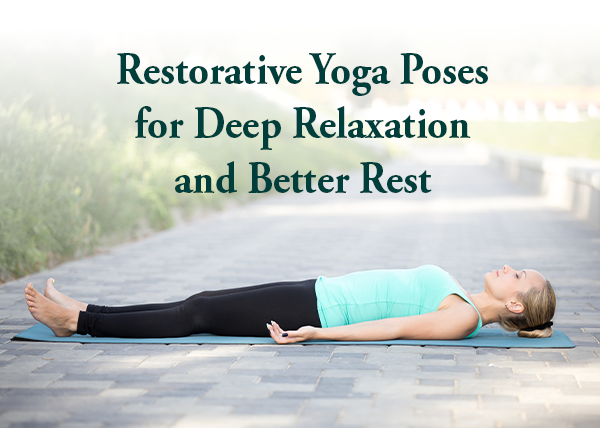
Savasana is the ultimate restorative yoga pose, and it is often described as the most important and the hardest pose in all of yoga. It looks simple: you lie flat on your back. But the practice of truly letting go requires patience and attention.
How to do it:
- Lie on your back on your mat.
- Let your legs fall naturally apart and your arms rest a comfortable distance from your body, palms facing up.
- Place a folded blanket under your knees to ease any lower back tension.
- Cover yourself with a light blanket if you feel cool.
- Place an eye pillow over your eyes.
- Close your eyes and do nothing. Simply breathe and let go.
- Stay here for 10 to 20 minutes.
Benefits:
- Completely relaxes the entire body and mind
- Integrates the benefits of the yoga practice
- Reduces blood pressure and heart rate
- Deeply calming for the nervous system
- Can improve sleep quality when practiced before bed
Note: Many yoga teachers consider Savasana to be the goal of the entire practice everything else prepares you for this complete, conscious rest.
7. Supported Forward Fold (Paschimottanasana)
A passive forward fold over a bolster is one of the most soothing restorative yoga poses you can practice. It calms the brain and gently stretches the back of the body without any effort.
How to do it:
- Sit on your mat with your legs extended in front of you.
- Place a bolster (or a stack of folded blankets) across your thighs.
- Gently fold forward and rest your head and arms on the bolster.
- Close your eyes and breathe slowly and deeply.
- Hold for 3 to 5 minutes.
Benefits:
- Calms the brain and relieves stress and mild depression
- Gently stretches the hamstrings, spine, and shoulders
- Stimulates the kidneys and liver
- Helps relieve headaches and fatigue
- Encourages introspection and quiet
8. Side-Lying Relaxation Pose {#side-lying-relaxation-pose}
This is a wonderful alternative to Savasana for people who are pregnant, have lower back issues, or simply find lying flat uncomfortable.
How to do it:
- Lie on your left side with your knees slightly bent.
- Place a bolster or a stack of blankets between your knees.
- Rest your head on a folded blanket or a pillow.
- Let your top arm rest on your side or on an additional blanket for support.
- Close your eyes and breathe naturally for 5 to 15 minutes.
Benefits:
- Deeply restful and safe for all body types
- Especially recommended during pregnancy
- Relieves pressure on the lower back and hips
- Encourages deep, restorative rest
- Useful as a sleep preparation pose
How Long Should You Hold Restorative Yoga Poses?
Unlike active yoga poses where you might hold for just 5 breaths or 30 seconds, restorative yoga poses are held for much longer typically between 3 and 20 minutes per pose. Here is a general guide:
| Pose | Recommended Hold Time |
| Child’s Pose | 3–5 minutes |
| Legs Up the Wall | 5–10 minutes |
| Supported Reclining Bound Angle | 5–10 minutes |
| Supported Bridge Pose | 3–5 minutes |
| Reclining Twist (each side) | 3–5 minutes |
| Supported Forward Fold | 3–5 minutes |
| Corpse Pose (Savasana) | 10–20 minutes |
| Side-Lying Relaxation | 5–15 minutes |
The longer you hold a restorative pose safely and comfortably, the more deeply your nervous system can relax. However, comfort is key. If a pose creates pain or strong discomfort, adjust your props or come out of the pose.
Best Time to Practice Restorative Yoga
Restorative yoga poses can be practiced at any time of day, but here are some popular and effective windows:
- Evening (before bed): This is probably the most popular time. A 20–40 minute restorative session in the evening can significantly improve your ability to fall asleep and the quality of your sleep.
- Afternoon slump: Instead of reaching for a third coffee, try 10–15 minutes of restorative yoga poses to refresh your energy naturally.
- After intense exercise: Restorative yoga is excellent as a cool-down after running, cycling, or more vigorous yoga to help your muscles recover faster.
- During illness or fatigue: When you are feeling run down, restorative yoga is much more beneficial than active exercise.
- During times of high stress: Any time stress levels are elevated, restorative yoga poses offer the body a genuine pause.
Restorative Yoga for Special Groups
Restorative yoga is suitable for nearly everyone, but it is especially valuable for certain groups:
Pregnant Women
Pregnancy brings enormous physical and emotional changes. Restorative yoga poses adapted for pregnancy can relieve back pain, reduce swelling in the legs and feet, calm anxiety, and prepare the body for birth. Poses like Side-Lying Relaxation and modified Child’s Pose (with knees wide and bolster support) are particularly beneficial.
At Canada Yoga Studio, we offer dedicated Prenatal Yoga classes that incorporate restorative elements to support you through every stage of your pregnancy journey.
New Mothers
After giving birth, the body needs significant recovery time. Restorative yoga helps postpartum recovery by addressing muscle fatigue, supporting hormonal rebalancing, and providing mental calm in what can be an overwhelming time. Many postpartum women find restorative yoga poses to be one of the first forms of movement they can return to safely after birth.
Explore our Postpartum Yoga program at Canada Yoga Studio, designed specifically to support new mothers.
Children
Yes even children can benefit from restorative yoga poses! With the increasing pressures children face academically and socially, teaching them to slow down, breathe, and rest is an invaluable skill. Simple, supported poses help children manage emotions, improve focus, and sleep better.
Check out our Kids Yoga sessions at Canada Yoga Studio.
Seniors
Restorative yoga is ideal for older adults because it places no strain on the joints and can be fully adapted to any physical limitation. It supports circulation, reduces pain and stiffness, and improves overall wellbeing.
People Managing Chronic Stress or Anxiety
For those dealing with long-term stress, burnout, or anxiety, restorative yoga poses offer a structured, accessible way to teach the body how to genuinely relax a skill many of us have lost in the modern world.
How Restorative Yoga Connects With Other Wellness Practices
Restorative yoga does not exist in isolation. It works beautifully alongside several other wellness practices:
Sound Healing
Combining restorative yoga poses with sound healing using singing bowls, gongs, and other instruments creates an even deeper relaxation response. The vibrations from sound healing tools help release tension in the body on a cellular level while you rest in your supported poses.
At Canada Yoga Studio, we offer Sound Healing sessions in Calgary that you can pair beautifully with your restorative practice.
Hatha Yoga
Hatha yoga and restorative yoga complement each other well. While Hatha builds strength, flexibility, and mindful movement, restorative yoga provides the balance of deep rest and recovery. Together they create a complete, well-rounded practice.
Learn more about our Hatha Yoga classes in Calgary.
Pranic and Aura Cleansing
Restorative yoga opens the body energetically, making it a wonderful companion to practices like Pranic and Aura Cleansing, which work on releasing energetic blocks and restoring your natural energy field.
Multi-Dimensional Yoga
For those interested in a deeper, more holistic approach, Multi-Dimensional Yoga at Canada Yoga Studio combines physical, mental, and spiritual dimensions of yoga practice into an integrated experience.
Nutrition and Wellness Coaching
What you eat and how you nourish your body has a direct impact on how well you sleep and how effectively you recover from stress. Pairing your restorative yoga practice with good nutrition guidance can amplify your results significantly.
Explore our Nutrition and Wellness Coaching services at Canada Yoga Studio.
Tips to Get the Most Out of Your Restorative Yoga Practice
Here are some practical, easy-to-follow tips to help you get the most from your restorative yoga poses:
- Set up before you begin. Gather all your props before you start so you are not interrupting your session to hunt for a blanket.
- Use a timer. Set a gentle alarm so you do not need to watch the clock. This lets your mind fully relax without worrying about time.
- Keep the room warm. Your body temperature drops during deep relaxation. Having a light blanket on hand helps.
- Dim the lights. Bright light signals wakefulness to your brain. Dim the lights or use an eye pillow to help your nervous system settle.
- Turn off your phone. Notifications and alerts are the enemy of restorative yoga. Put your phone on airplane mode or silent for your practice.
- Use an eye pillow. The gentle weight of an eye pillow on your eyes activates the oculocardiac reflex, which naturally slows your heart rate.
- Play soft background music or nature sounds. Calming audio can help your mind settle, though many practitioners prefer complete silence.
- Practice consistently. Like any wellness habit, restorative yoga poses are most effective when practiced regularly even 2 to 3 times per week makes a noticeable difference over time.
- Be patient with your mind. It is completely normal for your mind to wander, feel restless, or resist stillness at first. This is part of the practice. Gently bring your attention back to your breath each time.
- Consider joining a class. Practicing with a qualified teacher, especially in the beginning, helps you set up poses safely and get the full benefit of the practice.
Ready to experience restorative yoga in person? Visit Canada Yoga Studio to explore our class schedule and find the right session for you.
Frequently Asked Questions
Q: Is restorative yoga good for beginners?
Absolutely. Restorative yoga is one of the most beginner-friendly styles of yoga available. There is no flexibility required and no experience needed. The poses are fully supported, so anyone can participate regardless of their fitness level.
Q: Can I do restorative yoga every day?
Yes, you can practice restorative yoga poses daily. Because the practice is passive and places no strain on the muscles or joints, daily practice is safe and even encouraged for people dealing with high stress, fatigue, or recovery from illness.
Q: Will restorative yoga help me lose weight?
Restorative yoga is not primarily a calorie-burning activity, but it can indirectly support healthy weight management. By lowering cortisol levels and improving sleep quality, it helps regulate hormones that influence appetite and fat storage. Combining it with Nutrition and Wellness Coaching can further support your goals.
Q: How is restorative yoga different from yin yoga?
Both are slow, held-pose practices, but they work differently. Yin yoga targets the deeper connective tissues (fascia, ligaments, joints) and may involve some sensation or mild discomfort. Restorative yoga is focused entirely on comfort and passive relaxation there should be no stretch sensation at all. You are simply resting in a fully supported position.
Q: Do I need a bolster for restorative yoga?
A bolster is very helpful, but not strictly necessary. Firm, tightly rolled blankets can substitute in most poses. However, if you plan to practice regularly, investing in a proper yoga bolster is worthwhile.
Q: Can restorative yoga help with insomnia?
Many people find that regular practice of restorative yoga poses, especially in the evening, helps them fall asleep faster and stay asleep longer. This is supported by research showing that yoga-based relaxation practices reduce the physiological arousal associated with insomnia. If you struggle with sleep, even 15–20 minutes of restorative yoga before bed can make a meaningful difference.
Q: Is restorative yoga safe during pregnancy?
Generally yes, with modifications. Certain poses need to be adjusted during pregnancy for example, lying flat on your back for extended periods is not recommended after the first trimester. A qualified prenatal yoga teacher can guide you safely. Canada Yoga Studio’s Prenatal Yoga program is specifically designed with your safety and comfort in mind.
Final Thoughts
Restorative yoga poses offer something that is genuinely rare in our modern world: a structured, intentional invitation to truly rest. Not the kind of rest where you scroll through your phone or half-watch television, but deep, conscious, physical, and mental relaxation that your body and nervous system actually need to heal and recharge.
Whether you are dealing with stress, sleep trouble, physical fatigue, or simply the ordinary wear of everyday life, incorporating restorative yoga poses into your routine can make a real and lasting difference in how you feel. The poses are simple, the props are easy to gather, and the practice itself asks very little of you which is exactly the point.
From classic poses like Child’s Pose and Legs Up the Wall to the deep surrender of Savasana, every restorative yoga pose is an opportunity to let go a little more. Over time, that letting go adds up to something significant: better sleep, a calmer mind, a less tense body, and a more grounded relationship with yourself.
At Canada Yoga Studio, we believe that yoga is for every body and every stage of life. Whether you are new to yoga, expecting a baby, recovering postpartum, looking for a mindful practice for your child, or searching for a deeper approach to wellness, we have something for you.
👉 Explore our full range of classes and wellness services at Canada Yoga Studio and take your first step toward deeper rest and relaxation today.
External Resources for Further Reading: