
Chair Yoga for Seniors: Gentle Practices for Mobility and Balance

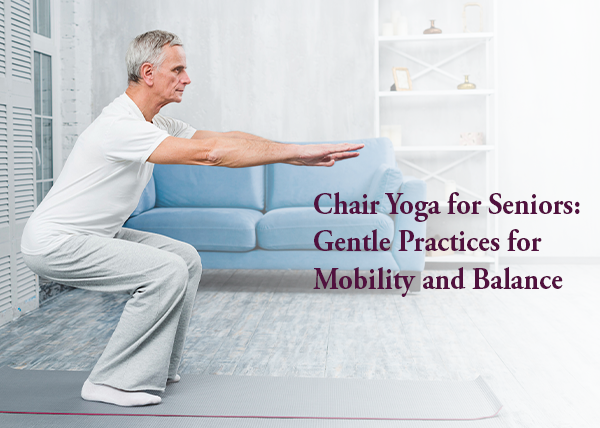
Chair yoga for seniors adapts traditional yoga movements so that many exercises can be performed while seated or with a sturdy chair used for support. For older adults who find floor transitions difficult, who are returning to movement after a period of rest, or who simply prefer a more supported form of physical activity, chair yoga can offer a practical and accessible entry point. It does not require a mat on the floor, and it does not demand flexibility you do not currently have. You work with your body as it is today.
What Is Chair Yoga for Seniors?
Chair yoga is an adapted yoga practice that uses a chair for seated movement or standing support. It can include gentle mobility work, stretching, light strength movements, breath awareness and supported balance exercises. This makes yoga more accessible for some older adults, beginners and people with limited mobility who may find conventional mat-based yoga difficult to start or sustain.
Quick Takeaways
- Chair yoga adapts yoga movements using seated or chair-supported positions, reducing the need for floor transitions.
- It can provide an accessible way to practise gentle mobility, light strength and breath awareness.
- Balance training may require appropriately challenging, chair-supported standing movements rather than seated exercises alone.
- Individual modifications matter smaller movements and shorter sessions are entirely valid starting points.
- Consistency over time is more useful than forcing movements that are uncomfortable or beyond your current range.
Why Chair Yoga Can Be a Practical Option for Older Adults
There are many reasons someone might choose gentle yoga for seniors over a conventional mat-based class, and most of them have nothing to do with physical limitation being a barrier to living well.
Some older adults find getting down to the floor and returning to standing increasingly effortful or uncomfortable. Others are returning to regular movement after illness, surgery or a period of reduced activity and prefer additional support while they rebuild confidence. Some people simply enjoy lower-impact activity and find that a chair-supported practice fits more naturally into their day.
Accessible yoga for seniors can also appeal to people who:
- Are new to yoga and want to ease into movement gradually
- Have had a joint replacement or a recent health event and are in an appropriate recovery stage
- Experience stiffness in the mornings and want a gentle movement practice to work through it
- Prefer not to use a mat on the floor for practical or preference-based reasons
Chair Yoga Is Not Only for People With Limited Mobility
It is worth being clear: chair yoga is not exclusively for people with physical limitations. It can appeal to:
- Beginners who want a lower-pressure introduction to yoga
- Older adults who work at a desk and want a movement break during the day
- People rebuilding confidence in movement after a gap in physical activity
- Anyone who wants the option of additional support while exploring yoga
Chair yoga does not imply fragility. It simply offers more options.
Benefits of Chair Yoga for Seniors
Chair Yoga for Mobility and Everyday Movement
Chair yoga for mobility is not about performing impressive stretches. It is about giving joints and muscles an opportunity to move through a comfortable range, which can support the kinds of movement that matter in daily life.
Gentle, supported movement through the:
- Shoulders reaching up, across or behind
- Spine rotating, bending sideways or moving forward and back
- Hips lifting, rotating or opening through seated positions
- Knees and ankles extending, flexing and circling
…can help practise and maintain the kinds of movement used for reaching into a cupboard, turning to look behind you, getting up from a chair or walking around your home.
Chair yoga is not a guarantee of improved range of motion, but it may provide a consistent, accessible way to keep joints and muscles moving rather than remaining still.
Gentle Strength Work Without Getting on the Floor
Chair yoga is not simply passive stretching. Seated exercises for seniors can include:
- Controlled leg lifts and extensions
- Seated marching with alternating knee raises
- Supported standing with hand contact on the chair
- Arm movements that engage the shoulders and upper back
- Maintaining upright posture during seated holds
- Sit-to-stand variations, where appropriate
These movements can involve muscular effort without requiring floor transitions, heavy equipment or high-impact activity.
Chair Yoga for Balance: What It Can and Cannot Do
This is an important distinction that many articles skip over.
A chair used for support during seated exercises provides stability, which is helpful for mobility and comfort but it also means the balance system is not being challenged significantly.
Seated chair yoga is best suited to:
- Mobility
- Gentle movement
- Breath awareness
- Light seated strength
Chair-supported standing yoga may introduce:
- Weight shifting
- Gentle stability practice
- Supported standing poses
- Appropriate balance challenges with the chair available for safety
If improving balance is a priority, chair-supported standing movements offer more opportunity to gently challenge the stability system than seated-only exercises. Balance and strengthening activities can form part of a broader healthy-ageing approach, while individual needs and abilities always vary.
What Canadian Guidelines Say About Activity for Seniors
According to Government of Canada physical activity guidance, older adults benefit from a combination of physical activities that can include light movement, muscle- and bone-strengthening activities, and activities that challenge balance. The guidance also notes that people with mobility restrictions can engage in modified activities, including exercises performed at a chair or desk.
This means chair yoga particularly when it incorporates gentle strength, movement and some chair-supported balance work can be consistent with a broader active-living approach for older adults.
That said, chair yoga alone is unlikely to fulfil all recommended weekly physical-activity targets for most people. It works best as part of a broader approach to staying active, rather than a replacement for all other movement.
8 Best Chair Yoga Exercises for Seniors
Before beginning, use a sturdy chair placed on a stable, non-slip surface. Move only through a range that feels comfortable for you, and pause if you experience unusual pain, dizziness or any symptoms that concern you.
These exercises are a general educational resource and are not a substitute for individualized professional advice.
1. Seated Mountain Pose for Posture and Breath Awareness
Sit comfortably near the front of your chair with both feet resting flat on the floor. Allow your spine to find a natural upright position not rigidly straight, simply supported and comfortable. Let your shoulders soften away from your ears, and rest your hands on your thighs.
Take several slow breaths, noticing the movement of your ribcage and belly. This pose sets the foundation for the rest of your practice by helping you connect with your breathing and find a stable seated base.
2. Seated Cat-Cow for Gentle Spinal Mobility
From your upright seated position, begin to gently round your back on a slow exhale letting the chest soften slightly toward the thighs and the head drop gently forward. Then, on an inhale, slowly move in the opposite direction lifting the chest gently and allowing the lower back to arch lightly.
Move slowly between these two positions, letting your breathing guide the pace. This seated yoga exercise can provide gentle movement through the spine without strain. Avoid forcing the range small, comfortable movements are completely appropriate.
3. Seated Side Bend for Upper-Body Mobility
Sit upright and, on an exhale, reach one arm gently overhead and allow your torso to tilt to the opposite side. Keep both sitting bones on the chair seat and breathe into the side of the body that feels gently lengthened. Hold briefly, then return on an inhale and repeat on the other side.
If reaching overhead is uncomfortable for your shoulder, you can keep the hand resting on your thigh and simply allow the torso to tilt. Work within a comfortable range at all times.
4. Gentle Seated Twist
From an upright seat, place one hand on the opposite knee and gently turn your torso in that direction on an exhale allowing your gaze to follow if comfortable. Keep the movement slow and controlled, and avoid using your hands to force the rotation further than your body naturally moves.
Hold for a breath or two, return to centre and repeat on the other side. If spinal rotation is uncomfortable for you, this pose can be reduced to a very small turn or skipped entirely.
5. Seated Marching for Hip Movement and Coordination
Sitting upright with feet flat, slowly lift one knee a comfortable height, then lower it and lift the other. Continue in an easy alternating rhythm this is seated marching. Your pace can be as slow as you like, and the height of each lift can be small.
You can keep your hands resting on your thighs throughout if that feels more supported. This movement can provide gentle hip flexion, light coordination practice and a mild increase in circulation to the lower limbs.
6. Seated Knee Extension for Gentle Leg Strength
Sit near the front of your chair, then slowly straighten one leg to a comfortable extension not fully locked at the knee, simply extended to where it feels manageable. Hold briefly, then slowly lower the foot back to the floor. Repeat on the other side.
Focus on the quality and control of the movement rather than how high or fully straight the leg reaches. This can engage the muscles of the thigh in a gentle, chair-supported way.
7. Ankle Circles and Heel Raises for Lower-Leg Mobility
Lift one foot slightly off the floor and slowly rotate the ankle in a comfortable circle a few times in each direction. Then switch to the other foot. This is a simple mobility exercise for seniors that can keep the ankles moving through a useful range.
You can also try lifting both heels gently off the floor while keeping the balls of your feet in contact, then lowering slowly. Move at a comfortable, controlled pace and keep the movement small if needed.
8. Chair-Supported Standing and Weight Shifts
Stand behind or beside a sturdy chair, keeping both hands lightly in contact with the back or seat for support. With your feet hip-width apart, slowly shift a small amount of weight toward one foot, then gently return to centre and shift toward the other.
This gentle weight-shifting exercise can introduce a mild balance challenge while keeping support available. Do not remove your hands unless you feel confident and stable. Progress only at a pace that feels appropriate for your current ability.
Please note: People with significant balance limitations, a recent fall, or related health concerns may benefit from working directly with a physiotherapist or qualified instructor before attempting unsupported or standing balance movements.
A 15-Minute Chair Yoga Routine for Beginners
This is a general sample routine rather than an individualized exercise prescription. Adjust the timing, movement size and content to suit how you feel on any given day.
Minutes 1–2: Settle and Breathe
Settle into Seated Mountain Pose. Spend the first two minutes focusing simply on comfortable breathing and allowing any tension in the shoulders or jaw to soften.
Minutes 3–5: Upper-Body Mobility
Move gently through seated Cat-Cow, then a side bend to each side. Take your time between each movement and let your breathing guide the pace.
Minutes 6–9: Lower-Body Mobility
Practise seated marching for a couple of minutes, then move into knee extensions on each side. Finish this section with ankle circles and heel raises.
Minutes 10–12: Gentle Strength
Return to controlled leg movements either seated knee extensions with a brief hold or gentle sit-to-stand movements if that feels appropriate. Only include sit-to-stand if it is comfortable and safe for you to do so.
Minutes 13–14: Optional Supported Balance
Stand behind your chair and practise gentle weight shifts. Skip this section entirely if you prefer a fully seated practice. There is no pressure to include standing movements.
Minute 15: Quiet Breathing
Return to your seated position, close your eyes if comfortable, and spend the final minute with slow, easy breathing. Allow the body to settle before you stand.
Chair Yoga for Seniors With Limited Mobility
For those with more significant mobility considerations, chair yoga for limited mobility can be adapted further. There is no single correct version of this practice, and smaller movements are not lesser movements.
Adaptations that may help:
- Reduce the range of motion in every pose movement through a shorter range is still movement
- Remain fully seated throughout omit the standing section entirely
- Use a cushion or rolled blanket for additional seat height or lumbar support
- Keep both hands supported on the chair arms or thighs rather than moving them overhead
- Shorten the session five or ten minutes is a meaningful practice
- Move one side at a time, resting between sides
- Reduce repetitions and rest between exercises as needed
If you are navigating a specific health condition and looking for movement guidance suited to your individual situation, Canada Yoga Studio’s Ailment-Focused Yoga Workshop is designed to provide personalized support for people with individual mobility needs, rather than a generic group class format.
Chair Yoga for Seniors With Arthritis: What to Know
Many older adults living with joint conditions are interested in whether chair yoga might be helpful. The honest answer is that it depends significantly on which joints are affected, the severity of symptoms on any given day, and how movement is approached.
A randomized study of chair yoga in older adults with lower-extremity osteoarthritis found improvements in some outcomes including pain and fatigue but not in every outcome measured. Balance, for example, did not show statistically significant improvement in all measures. This is a useful reminder that chair yoga is not a one-size answer for arthritis, and expectations should be realistic.
What is generally understood is that appropriate, gentle movement is often preferable to prolonged inactivity for people with joint conditions. Chair yoga may provide a supported, low-impact way to keep moving but the specific movements may need modification, and some days may call for a much gentler session than others.
If you have a joint condition and are unsure which movements are appropriate, speaking with a physiotherapist or physician before beginning is a sensible step.
Chair Yoga vs Traditional Yoga for Seniors
| Feature | Chair Yoga | Traditional Mat Yoga |
| Floor transitions | Usually reduced or eliminated | Often included |
| Chair support | Central to the practice | Usually optional |
| Seated movements | Common throughout | Depends on style |
| Supported standing | Can be included | Often unsupported |
| Modifications available | Highly adaptable | Also adaptable |
| Best suited to | Depends on the individual | Depends on the individual |
Neither style is automatically better for every senior. The right practice depends on your current mobility, your goals, your health, your confidence in movement, your experience with yoga and your personal preference. Some older adults practise traditional mat yoga comfortably well into their 70s and beyond. Others find that chair yoga gives them exactly the supported approach they were looking for.
If you are interested in exploring a foundational, breath-aware yoga practice with guided instruction, guided Hatha Yoga sessions at Canada Yoga Studio offer a grounded, accessible approach to yoga that supports gradual progression.
How Often Should Seniors Do Chair Yoga?
There is no universal answer here, and it would be misleading to suggest otherwise.
Frequency depends on:
- Your current activity level
- Your health and any relevant medical considerations
- The intensity and duration of each session
- How your body responds and recovers
- Your mobility goals
- Whether chair yoga is your only form of physical activity or part of a broader routine
A sensible general approach is to start gradually perhaps two or three shorter sessions per week and build from there based on how you feel. Consistency over time is far more valuable than pushing through discomfort.
For broader context on how physical activity fits into healthy ageing, the Government of Canada physical activity guidance provides useful framing for older adults.
Can Chair Yoga Help With Balance and Fall Prevention?
Balance is worth addressing honestly. Fall risk in older adults is influenced by many factors including muscle strength, reaction time, medication, vision, footwear, and the environment and no single exercise approach can reliably eliminate that risk.
What can be said is that strength and balance-challenging exercises are broadly recognized as relevant to healthy ageing. Chair-supported standing movements that gently challenge your stability like the weight shifts described earlier can provide some balance practice with a safety net available.
Seated chair yoga, on its own, provides less balance challenge simply because you remain supported throughout. If balance is a specific concern for you or a family member, it is worth speaking with a physiotherapist or physician who can recommend an individualized program that directly addresses balance needs.
Chair yoga can be one useful and enjoyable part of staying active but it should not be positioned as a fall-prevention program in itself.
Is Chair Yoga Safe to Do at Home?
Chair yoga at home is practical and manageable for many people, with a few sensible precautions:
- Use a sturdy, stable chair a dining chair without wheels is typically appropriate
- Place the chair on a non-slip, stable floor surface avoid thick rugs that might shift
- Create enough clear space around and in front of the chair
- Keep mobility aids nearby if you normally use them do not put them out of reach during practice
- Remove obvious trip hazards from the area before you begin
- Follow video or audio guidance from a qualified instructor if you are new to the practice
- Avoid unsupported standing balance work at home if you have significant balance concerns
For those new to chair yoga, an online class or an in-person guided session can help you learn correct positioning and modifications before practising independently at home.
When Guided Chair Yoga May Be a Better Choice
Practising with a qualified yoga instructor offers something an article cannot: real-time feedback and adjustment.
An experienced instructor can:
- Observe your individual range of motion and suggest appropriate modifications
- Help you set up your chair and posture safely
- Guide you through the difference between seated and supported-standing exercises
- Offer progressive challenge as your practice develops
- Support breath coordination alongside movement
- Help you feel confident rather than uncertain about a new practice
Guided instruction does not eliminate all risk, but it can significantly reduce the guesswork particularly for someone new to yoga or navigating a specific health consideration.
If you are in Calgary and would like personalized, guided yoga in a studio setting, you are welcome to explore in-studio yoga sessions at Canada Yoga Studio and find a format that suits your schedule and comfort level.
Which Type of Chair Yoga Practice May Suit You?
If getting onto the floor is difficult:
Start with a fully seated practice. There is no need to include standing elements at all in the beginning.
If seated movement feels comfortable but balance is a concern:
Consider chair-supported standing exercises with hand contact on the chair throughout, and ideally with some guidance from an instructor or physiotherapist.
If you are already fairly active:
Use the chair as a convenient prop rather than limiting the entire practice to seated movements. The chair can support a broader range of poses than you might expect.
If you have a specific medical or mobility consideration:
Seek individualized guidance before beginning, either from a physiotherapist, your physician or a yoga instructor experienced with adaptive practice.
Chair Yoga for Seniors: Frequently Asked Questions
Is chair yoga really effective for seniors?
Chair yoga can be a useful and accessible form of movement for many older adults. Research has explored chair yoga in older adults with joint conditions and found improvements in some outcomes such as pain and fatigue. It may support mobility and gentle strength when practised consistently, though results vary and it is not a solution for every health concern.
What are the best chair yoga exercises for seniors?
Useful starting points include Seated Mountain Pose, seated Cat-Cow for spinal movement, seated marching for hip mobility, ankle circles and heel raises for lower-leg movement, and gentle seated knee extensions. Chair-supported weight shifts can introduce mild balance work for those who are comfortable with standing.
Can chair yoga improve mobility?
It may support mobility by providing regular, gentle movement through the joints and muscles involved in everyday activities shoulders, spine, hips, knees and ankles. Chair yoga gives these areas an opportunity to move consistently, which can help maintain a comfortable range over time. It is not a guarantee of improved mobility for everyone.
Can chair yoga help improve balance?
Seated chair yoga provides limited balance challenge because the chair provides support throughout. Chair-supported standing exercises such as weight shifts can introduce more appropriate balance practice. Balance training is most effective when it progressively challenges stability in a safe way, and individual guidance may be valuable.
Is chair yoga suitable for seniors with arthritis?
It may be suitable for some older adults with arthritis, particularly when movements are modified to match current comfort and ability. Research has found some improvements in pain and fatigue for older adults with lower-extremity osteoarthritis following a chair yoga program. However, affected joints, symptom severity and appropriate modifications vary between individuals. Medical or professional advice is worth seeking if you are unsure.
How often should seniors practise chair yoga?
This depends on your current activity level, health, the duration of each session and your broader movement routine. Starting with two or three shorter sessions per week and building gradually based on how you feel is a sensible approach. Consistency matters more than frequency or duration in the early stages.
Can chair yoga be done completely seated?
Yes. A chair yoga practice can be designed to remain entirely seated from start to finish. This is a valid and complete approach for anyone who prefers or requires it. Chair-supported standing elements are optional additions, not requirements.
What type of chair should I use for chair yoga?
A sturdy chair without wheels is typically the most appropriate choice a wooden or metal dining chair is often ideal. The seat height should allow your feet to rest flat on the floor comfortably. Avoid soft chairs that shift your weight back, and ensure the chair is placed on a stable, non-slip surface.
Start Chair Yoga With Movement That Meets You Where You Are
Yoga can be adapted. A chair can make that adaptation more accessible for a wide range of people not only those with significant physical limitations, but anyone who wants a supported, low-impact and accessible form of movement in their day.
Small seated movements still count. Gentle strength work without getting on the floor still counts. Ankle circles, seated breathing and supported weight shifts all count as meaningful physical activity, particularly when practised consistently over time.
If balance is a priority, look for opportunities to introduce chair-supported standing exercises and consider professional guidance on how to build appropriate challenge safely. If mobility is the goal, focus on moving the joints and muscles that matter most in your daily life.
Wherever you are starting from, the most useful thing is to begin in a way that feels manageable and build from there.
Looking for a yoga practice adapted to your mobility, experience and comfort level? Explore personalized guided yoga at Canada Yoga Studio or visit our Ailment-Focused Yoga Workshop to find the right starting point for your individual needs.