
Yoga for Joint Pain and Arthritis: Gentle Poses to Support Mobility and Comfort

When knees, hips, hands or shoulders feel stiff, the natural reaction can be to move less. But for many people, the more useful question is not whether movement should stop entirely it is how movement can be adapted to feel manageable and comfortable.
Yoga for arthritis does not mean performing advanced poses or working toward extreme flexibility. At its most practical, gentle yoga combines controlled movement, mobility work, balance, strength-building and breathing all within a range that makes sense for the individual body and joint. That adaptability is what makes it a genuinely accessible option for people experiencing joint stiffness or discomfort.
If you are managing arthritis or joint sensitivity and are looking for movement with structure, Canada Yoga Studio’s personalized Ailment-Focused Yoga Workshop is one guided option that brings individualized modifications into every session.
The sections below walk through how gentle yoga works, which poses tend to be practical for common areas of stiffness, how to adapt for knees, hips and hands, and how to build a short daily routine that you can realistically sustain.
Is Yoga Good for Arthritis and Joint Stiffness?
Gentle, appropriately modified yoga can provide a practical way to work on movement, mobility, strength, balance and body awareness. However, arthritis affects people and joints differently, so the type, range and intensity of yoga should be adapted rather than assuming every pose suits everyone. Research suggests that regular, comfortable movement may support everyday function for some people, but individual responses vary.
To put it simply: yoga is not a treatment for arthritis, but a thoughtfully adapted practice can offer a way to keep moving on your own terms.
Why Arthritis Can Make Movement Feel Different?
“Arthritis” describes more than one condition, which is important to understand before choosing any movement practice.
Osteoarthritis
Osteoarthritis is the most commonly discussed form and tends to affect joints that carry significant load or use over time knees, hips and hands are among the most frequently involved. It often involves gradual changes to joint tissue, which can lead to stiffness and reduced comfortable range of motion.
Rheumatoid Arthritis
Rheumatoid arthritis works differently. It is an autoimmune condition that can affect multiple joints and may involve periods of greater and lesser symptom activity. Because of this variability, a yoga practice for someone with rheumatoid arthritis may need to be more flexible in its intensity from day to day.
The key point here: the same yoga approach should not be automatically applied to every person with arthritis. What works well for one person’s knees may not suit another’s hips, and what feels manageable one day may need adjusting the next.
Yoga for Arthritis Is About Adaptation, Not Forcing Flexibility
One of the most important ideas in any gentle yoga for arthritis practice is letting go of the idea that a pose needs to look a particular way.
The goal is not:
- Reaching the floor
- Holding the deepest variation of a stretch
- Copying what someone else’s body can do
- Pushing through a movement that creates significant discomfort
Instead, a useful practice focuses on:
- Moving through a comfortable range rather than a maximum one
- Keeping movement controlled rather than rushed
- Building strength alongside mobility
- Developing body awareness noticing what feels useful and what does not
- Coordinating breath with movement, which can also support a calmer nervous system response
A smaller, comfortable movement practised consistently can be more useful than forcing a deeper pose that leaves a joint feeling worse the following day.
Yoga for Arthritis: Quick Takeaways
- Gentle yoga can be adapted according to individual joint mobility, not a universal standard.
- Yoga for arthritis should focus on comfortable movement rather than maximum flexibility.
- Chairs, blocks, walls and cushions can make poses easier to modify for different bodies.
- Strength and stability are just as important as stretching in a joint-friendly practice.
- A smaller range of motion is still a meaningful yoga practice and often a smarter one.
How Gentle Yoga May Support Joint Mobility and Everyday Movement
Practising Joint Mobility
Gentle yoga can move joints shoulders, hips, knees, ankles, spine and wrists through comfortable, controlled ranges. Doing this regularly, without forcing range, can be a practical way to maintain the mobility that supports everyday tasks like walking, carrying or reaching.
Building Strength Around Joints
Yoga is not only stretching. Many controlled poses involve meaningful engagement of the legs, hips, core, upper body and stabilizing muscles. Building strength around a joint can provide a more supportive environment for movement. This is not the same as claiming that stronger muscles cure arthritis it simply means that strength and mobility work well together in practice.
Supporting Balance and Body Awareness
Slower yoga movement encourages awareness of body position, weight distribution and transitions. This kind of controlled movement, particularly in supported standing poses, can build confidence in everyday mobility without introducing unnecessary instability.
Making Movement More Adaptable
One of yoga’s most practical advantages for people with varying mobility is that most poses can be adjusted using tools already in your environment a chair, a wall, a yoga block, a cushion or a strap. Reducing the range, adding support or choosing a seated variation are all legitimate parts of the practice, not workarounds or signs of weakness.
The Government of Canada’s physical activity guidance supports the idea that staying active, in ways appropriate to individual capacity, forms part of overall health maintenance. Gentle yoga can be one practical form of that movement.
8 Gentle Yoga Poses for Arthritis and Stiff Joints
Use a comfortable range throughout and modify any position that does not suit the joint you’re working with. Every pose below has a natural adaptation built in.
1. Mountain Pose for Posture and Body Awareness
Mountain Pose is a standing pose that focuses on alignment rather than movement. Stand with feet hip-distance apart, knees slightly soft rather than locked, shoulders relaxed and breath steady. If balance feels uncertain, stand with your back close to a wall for gentle support. This pose builds the body-awareness foundation that makes other standing poses more manageable.
2. Cat-Cow for Gentle Spinal Mobility
Cat-Cow is one of the most practical poses for yoga for joint stiffness because it moves the spine in a controlled, rhythmic way. On hands and knees, gently arch the back on an inhale and round it on an exhale, moving through a comfortable range rather than the full extreme of each direction.
If getting onto hands and knees is uncomfortable, a seated version works well: sit upright in a chair, place hands on knees and gently arch and round the spine with the breath. The movement benefit is similar.
3. Chair-Supported Warrior II
Warrior II is typically a standing pose with a bent front knee, but it can be adapted significantly. Use a chair beside you or stand near a wall. Take a comfortable stance shorter than the traditional wide version and allow the front knee to bend to whatever degree feels stable and comfortable. The point is not the depth of the lunge but the practice of stable, supported standing with awareness.
4. Supported Low Lunge for Hip Mobility
Hip mobility is one of the most common concerns in yoga for hip stiffness, and a supported low lunge can help work the hip flexors gently. From a kneeling position, step one foot forward. Place a folded blanket or cushion under the back knee and use blocks on either side for hand support. Reduce the length of the stance if a longer lunge feels like too much. This pose does not need to be deep to be useful.
5. Seated Knee Extensions for Gentle Leg Movement
Sit upright in a firm chair. Slowly extend one leg to a comfortable height, hold briefly, then lower it back down with control. Alternate legs. This movement works the front of the thigh and keeps the knee joint moving without requiring floor work or deep bending. Keep the range comfortable there is no need to extend the leg fully flat if that creates tension.
6. Ankle Circles and Heel-Toe Movements
Seated or lying down, lift one foot slightly and draw slow circles with the ankle in both directions. Then try gently flexing and pointing the foot. These small movements can help maintain ankle mobility, which contributes to more stable walking and standing. Simple and practical, they are easy to include at the beginning or end of any session.
7. Gentle Wrist and Finger Movements
For those dealing with yoga for hand arthritis or wrist sensitivity, beginning a practice with hand warm-ups can make weight-bearing poses more comfortable. Open and close the hands slowly, draw gentle circles with the wrists in both directions, and move each finger individually where possible. These movements are appropriate for chair-based practice and can be done seated at any time of day.
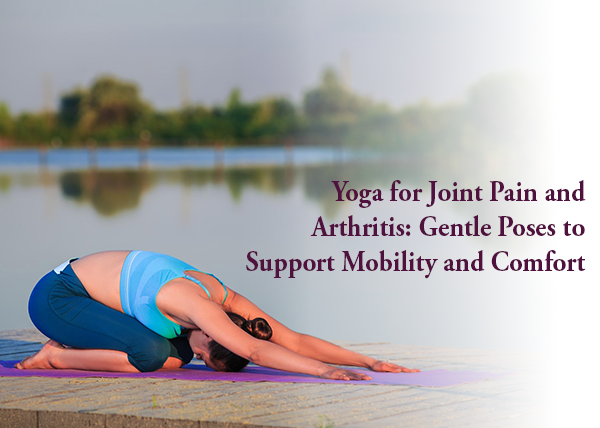
8. Supported Child’s Pose or Seated Resting Variation
Traditional Child’s Pose involves kneeling and folding the torso forward a position that does not suit everyone’s knees or hips. Use a bolster or folded blanket under the chest and thighs for support, or bend to whatever comfortable degree is available. If kneeling is not appropriate, sit upright in a chair, place a cushion on your lap and rest the torso and forearms forward onto it. Rest is part of the practice, not a pause from it.
How to Modify Yoga for Different Joints ?
Yoga for Knee Arthritis and Knee Stiffness
For yoga for knee arthritis, the main adjustments involve reducing depth and adding support:
- Shorten your stance in lunges and Warrior poses
- Use a chair or wall for balance in standing poses
- Place padding under the knee in any kneeling position
- Avoid prolonged kneeling if it becomes uncomfortable
- Keep a soft bend in standing knee rather than locking or deeply bending
The goal is to keep the knee joint moving comfortably, not to test its range.
Yoga for Hip Arthritis and Hip Stiffness
For yoga for hip arthritis, the priority is reducing force on the hip joint during movement:
- Reduce the depth of lunges significantly
- Use blocks under hands in forward folds
- Experiment with a slightly wider or narrower stance comfort varies significantly between individuals
- Avoid forcing deep hip-opening poses like Pigeon if they create discomfort in the joint itself rather than just a stretch sensation
Yoga for Hand and Wrist Arthritis
Extended weight-bearing through the hands as in traditional hands-and-knees positions may not be comfortable for yoga for hand arthritis. Alternatives include:
- Making fists to distribute weight across knuckles rather than open palms
- Using forearm support instead of hand support
- Choosing chair-based variations that keep weight off the wrists
- Keeping hands-and-knees time brief when wrists are sensitive
Yoga for Shoulder Stiffness
Shoulder-related stiffness calls for reducing overhead range:
- Keep arms at shoulder height or lower rather than extending fully overhead
- Use bent arms in standing poses instead of straight raised arms
- Practise gentle shoulder rolls and circles from a seated position
- Use a wall for light hand support in movements that benefit from stability
Can Chair Yoga Help People With Arthritis or Limited Mobility?
Chair yoga provides a way to access many of the same movement principles mobility, breath coordination, gentle strength, body awareness without floor transitions or extended standing. For people with limited mobility, significant joint sensitivity or those who are less confident on their feet, a chair provides a stable base from which almost any movement can be adapted.
Seated ankle circles, spinal mobility, hip movements, gentle arm sequences and breathing practices can all be done from a chair effectively. The chair is a tool for adaptation not a signal that someone is “too old” or “too limited” for yoga. It is simply a practical modification that removes a barrier.
That said, chair yoga is not automatically better for every person with arthritis. Some people with joint stiffness do well with supported standing work and benefit from the stability challenge. The best approach is the one that allows comfortable, consistent movement.
For a guided approach to these kinds of adaptations, Canada Yoga Studio’s Ailment-Focused Yoga Workshop is designed specifically to address movement concerns with individualized modifications.
Is Hatha Yoga a Good Option for Stiff Joints?
Hatha Yoga for arthritis is often mentioned as a starting point, and there are practical reasons for that. A typical Hatha Yoga class moves at a slower pace than more dynamic styles, which allows more time for:
- Setting up each pose carefully
- Adjusting alignment and support before moving deeper
- Coordinating breath with movement
- Making use of props
- Transitioning between positions with control
However, not all Hatha Yoga classes are automatically gentle. Intensity varies between teachers and studios. If you are new to yoga or managing joint sensitivity, choosing a class explicitly described as beginner or gentle is worthwhile.
Canada Yoga Studio’s guided Hatha Yoga program emphasizes mindful movement, breath awareness and foundational practice with modifications available for different experience levels making it a practical choice for those starting with joint-related concerns.
A 15-Minute Gentle Yoga Routine for Joint Mobility
Adjust the range, support and duration to what feels comfortable for your body that day.
Minutes 0–3 Gentle Warm-Up
Begin seated. Draw slow circles with both ankles. Move through gentle wrist rotations and open-and-close hand movements. Roll the shoulders forward and back a few times. Take three slow, steady breaths to settle into the practice.
Minutes 3–6 Spinal and Hip Mobility
Move through seated or hands-and-knees Cat-Cow, coordinating each movement with the breath. Follow with a gentle seated side bend reach one arm overhead or simply lean slightly to the side, whichever is more comfortable. Spend a minute on supported hip movement from a standing or seated position.
Minutes 6–10 Supported Strength and Stability
Come to standing near a chair or wall. Practise Mountain Pose with relaxed knees and steady breath. Move into a supported Warrior II at a comfortable, shorter stance. Practise a few controlled weight shifts from one foot to the other to build stability awareness.
Minutes 10–13 Seated Lower-Body Mobility
Return to the chair. Practise slow seated knee extensions, alternating legs. Follow with ankle circles and gentle foot flexion and extension. If hips allow, try a gentle seated figure-four position crossing one ankle over the opposite thigh at a comfortable angle.
Minutes 13–15 Gentle Breathing and Rest
Return to a comfortable seated or supported resting position. Allow the breath to slow. Take three to five deep, natural breaths. Notice any areas that feel more open than when you began.
Gentle Joint-Mobility Yoga Routine at a Glance
| Time | Practice | Focus |
| 0–3 min | Joint warm-up | Gentle mobility |
| 3–6 min | Cat-Cow + hip movement | Spine & hips |
| 6–10 min | Supported standing poses | Strength & stability |
| 10–13 min | Seated movements | Knees & ankles |
| 13–15 min | Breath + rest | Slower finish |
6 Yoga Mistakes to Avoid When Your Joints Feel Stiff
1. Forcing a Pose Because It “Should” Look a Certain Way
A pose that looks different from a textbook image is not a failed pose it is a modified one. Comfort and control matter more than appearance.
2. Moving Into the Deepest Range Immediately
Joints benefit from gradual warming. Begin with smaller movements and progress only if comfort genuinely allows it, not because it feels like the “correct” thing to do.
3. Locking the Knees During Standing Poses
Locked knees place more pressure on the joint. Keeping a micro-bend in standing poses protects the knee and creates more stable, controlled movement.
4. Ignoring Props Because They Feel Like “Cheating”
A block, chair, strap or cushion is not a sign of weakness. These tools allow you to practise more safely and consistently. Experienced practitioners use them regularly.
5. Treating Every Day as the Same
Joint comfort and mobility naturally vary from day to day. A practice that suited you well on Monday might need to be shorter or gentler on Thursday. Adjusting to how your body feels on any given day is not inconsistency it is good awareness.
6. Assuming More Stretching Is Always Better
Overstretching an already unstable joint can create more discomfort. Strength, control and range working together is a more balanced goal than chasing the deepest possible stretch.
What If Your Joints Feel More Sensitive Than Usual?
On days when a joint feels noticeably more reactive, there is no need to skip movement entirely. Instead, consider:
- Choosing a smaller, more comfortable range for every movement
- Replacing standing poses with seated equivalents
- Spending more time on breath awareness and gentle upper-body work
- Shortening the session to ten minutes rather than thirty
- Choosing a restorative or resting position with breath focus
The practice does not disappear on harder days it simply adapts. What matters is that the movement feels appropriate for where your body is that particular day, not where it was last week.
Which Type of Gentle Yoga Practice Fits How You Feel Today?
If Your Joints Feel Stiff but Comfortable to Move
Choose gentle mobility, slow Hatha movement and supported standing poses. Work through the full 15-minute routine above at a pace that allows breath coordination throughout.
If Floor Transitions Feel Difficult
Choose chair yoga or wall-supported poses. Almost every movement in this article can be adapted to a seated position without losing its mobility focus.
If Knees Feel Sensitive
Reduce deep knee bends, avoid prolonged kneeling and use additional support a chair, block or wall for any standing balance work. Seated knee extensions remain a practical lower-body option.
If You Want to Build Strength Gradually
Use supported standing poses with controlled holds, gentle weight shifts and gradually longer practice sessions as comfort increases over time.
If You Want More Individualized Modifications
Canada Yoga Studio’s Ailment-Focused Yoga Workshop offers personalized modifications based on your specific joint concerns and current mobility a practical starting point if you are unsure where to begin or feel uncertain about adapting poses on your own.
For those who want to move toward a broader, integrated practice over time, Multi-Dimensional Yoga combines mobility, flexibility, strength, breathwork and restorative practice in a format that can be adapted to different levels.
Why Personalized Yoga Modifications Matter for Joint Comfort
Practising with an experienced instructor who understands joint limitations can make a meaningful difference to how comfortable and sustainable a yoga practice feels. A knowledgeable teacher can observe how you set up a pose and suggest:
- A slightly shorter or longer stance
- A different knee angle
- The most appropriate prop for your situation
- When a chair variation is more useful than a floor version
- How much weight to shift into a particular position
- When to reduce intensity and when gradual progression makes sense
This kind of guidance is not about treating arthritis it is about making yoga a genuinely accessible practice rather than a frustrating one. And that difference, between a practice that feels adapted to your body and one that does not, often determines whether someone continues or stops entirely.
Yoga for Arthritis and Joint Pain: Frequently Asked Questions
Is yoga good for arthritis?
Gentle, appropriately modified yoga can provide a practical way to maintain movement, build stability and develop body awareness. It is not a treatment for arthritis, but a consistent practice adapted to your joints may support everyday mobility for some people. Individual responses vary, so the type and intensity of yoga should be chosen based on personal comfort rather than general recommendations.
Which yoga is best for arthritis?
There is no single style that universally suits everyone with arthritis. Slower, more modifiable formats such as gentle Hatha Yoga or chair yoga tend to be practical starting points because they allow more setup time, prop use and alignment adjustment. The most important factor is finding a format where you can move comfortably and consistently.
What are the best yoga poses for stiff joints?
Mobility-focused, supported poses tend to work well: Mountain Pose, seated Cat-Cow, chair-supported Warrior II, supported low lunge, seated knee extensions, ankle circles, gentle wrist and finger movements, and bolster-supported resting poses. Choose based on which joints feel most relevant to your practice.
Can yoga help knee arthritis?
Yoga can be adapted to work with knee arthritis by reducing stance length, using a chair or wall for support, keeping knee bends shallow, avoiding prolonged kneeling and padding any floor-kneeling position. The goal is comfortable, controlled movement rather than testing the joint’s range. These modifications do not treat knee arthritis but may support keeping the joint mobile.
Is chair yoga good for arthritis?
Chair yoga is a practical and accessible option for people who find floor transitions uncomfortable or who need a stable support point. Almost all the mobility-focused movements in a standard gentle yoga practice can be adapted to a seated position. For many people, chair yoga removes barriers that might otherwise prevent consistent practice.
Should I do yoga when my joints feel stiff?
Often, yes with appropriate adaptation. Gentle movement can be one way to address stiffness, particularly in the morning or after periods of sitting. The key is choosing a comfortable range, using support where needed and not pushing into movements that create significant discomfort. On days when joints feel considerably more sensitive, reduce range or choose a shorter, gentler practice.
Is Hatha Yoga suitable for people with joint stiffness?
Hatha Yoga can be a practical format for joint stiffness because its slower pace allows more time for setup, alignment and breathing. It also tends to allow modifications more naturally than faster-paced styles. That said, the specific class and teacher matter look for classes described as gentle, foundational or beginner when joint sensitivity is a factor.
How often should I practise gentle yoga for mobility?
Consistency tends to matter more than duration. A short practice even 10 to 15 minutes done regularly is generally more useful than a long session once a week. Most people find that three to five shorter sessions per week is a sustainable starting point. Adjust frequency based on how your joints respond and how your energy levels vary from day to day.
Support Your Joints With Movement That Meets Your Body Where It Is
Joint stiffness and arthritis do not mean movement has to stop they mean movement needs to be thoughtful. A gentle yoga practice does not have to look like the poses in a fitness magazine. It can be slower, shorter, chair-based, prop-supported or focused entirely on comfortable range rather than deep flexibility. Strength and mobility both matter. Props are practical tools, not limitations. And your body on any given day is the best guide to how much or how little to do.
The goal is consistent, comfortable movement over time not a single impressive session.
If you are looking for a yoga practice adapted to your current mobility and comfort, explore Canada Yoga Studio’s personalized Ailment-Focused Yoga Workshop or start with guided Hatha Yoga sessions that build foundational movement with modifications for different bodies and experience levels.